Saturday was sunny! Nearly all day even! Which was lucky for us since we spent a lot of it outside.
We met John outside our flats Saturday morning for a walk through a new part of Glasgow. We walked down High Street getting bits of Glaswegian history along the way and eventually came to the Glasgow Green. The Glasgow Green is one of my favorite places in Glasgow so far. It's a large park made up of huge fields of grass, elegant lines of trees, and several historical monuments. However these monuments weren't all for war heroes and politicians - they were for more localized citizens and popular movements specific to Glasgow. There was even one for those who opposed the first World War, which I thought was especially fascinating. My favorite monument was to the women of the Temperance Movement given the irony of temperance in a country with such an emphasis on drinking in its culture.
The monument to the Temperance Movement in Glasgow Green
The Glasgow Green also shares a space with something called the People's Palace, another testament to the importance of the people themselves to Glasgow's identity. The People's Palace is a rather small museum devoted to the history of the people of Glasgow themselves. The exhibit details marriages throughout Glaswegian history, what school was like, the Temperance Movement, what jail was like, a favorite dance, homosexual history - it was all a lovely testament to the identity of Glasgow. The people of Glasgow are so embraced by their own city that the city's slogan itself is "People Make Glasgow" - which as Neil (our student ambassador) pointed out to us, is quite brilliant since you can add any word to the end of that phrase as well such as "People make Glasgow...musical" or "smart" or "beautiful" etc.
The People's Palace - quite literally named, clearly
The Commonwealth Games (an every four year sports affair at which all British Commenwealths, including former ones, compete against one another) were held in Glasgow last year, and this was their mascot, Clyde. He serves as another example of Glaswegian identity and pride.
Outside the People's Palace is a lovely Terracotta Fountain (the largest in the world actually!) called the Doulton Fountain. On top sits Queen Victoria looking out on her empire. This domineering statue of Queen Victoria is all over the city and apparently was erected during Britain's imperialistic moment in history as a symbol of the empire. Part of me wonders what would happen to these imperialistic images if Scottish Independence were to occur - but another part acknowledges that Scotland deeply values its history, and would probably keep them in place as a testament to their past and the massive legacy of English rule they had to overcome to be independence.
All of us outside the Doulton Fountain
After the People's Palace we got some lunch at a lovely pub nearby that supposedly sold the best beer in Glasgow - ironically it's German beer - but the food was certainly lovely.
After lunch, Neil brought us to the Merchant City Festival. We are so lucky to be in Glasgow for this festival. It is such an excellent representation of Glaswegian culture. Everyone is out and about on the streets looking in on the booths that are all completely decked out with either delicious deserts, crazy food, or little Scottish trinkets. I have never seen a more extensive street festival in all my life. We all had a lovely time exploring and talking with the vendors, trying amazing deserts and enjoying the musicians on the street. By the way, every single time we've been on the streets of Glasgow, there's always a street musician playing. From all ages and all types of music, there hasn't been one time without music - a lovely testament to the artisticness and creativity that is bursting from this city through every outlet whether it be music, film or theatre.
The Merchant City Festival in Glasgow
I was super excited to see the spread at the dessert booths - who knew Turkish Delight was actually delightful?
Although the music and the festivals are pretty grand, there is one thing I love even more about Glasgow - the police boxes. People, the Doctor could land the TARDIS in this city and no one would find it even remotely out of place. There are police boxes of every color throughout the entire city, although I like the blue ones best.
Me with a green TARDIS
Me with THE REAL TARDIS - shame on all the nonbelievers
After spending hours exploring the Merchant City Festival, we headed home to get some rest.
On Sunday, we all kind of split up and did our own things. History nerds as we are, Liam and I decided heading to Stirling was our top priority. As you might recall, Stirling is the location of the ever important Battle of Stirling BRIDGE - that's right Mel Gibson, the Battle of Stirling BRIDGE was on a bridge. Of course, it fell during the battle, so it's no longer there, but we were super duper close to where it was! By the way, all the Braveheart debunks are on a previous blog post - do take a peak if you haven't already. It's important.
Right, so Liam and I took a quick train to Stirling and were quickly smitten with the small town. It's quite historical. It even has little blue and gold signs throughout the whole place explaining the historical significance of old churches, buildings and bridges. Naturally, we loved that. We were a tad hungry when we arrived, and happened upon LORD DARNLEY'S HOUSE. If you don't recall, Lord Darnley was Mary Queen of Scots's second husband -- you know, the one that flew into murderous rages on occasion and killed David Rizzio in front of his very pregnant wife that one time. Good stuff. Anyway, it's casually been turned into a coffee house aptly titled "Darnley Coffee House." Naturally, Liam and I chose this place to stop for a bite. It was quite small with a couple decently sized rooms and the characteristic short doorways. It was a perfect start to our history-filled day.
The Darnley Coffee House - Lord Darnley's actual house
After our lunch, we headed up a hill and happened upon an awesome-looking church. Classic Scotland. We peaked inside and discovered it is the Church of the Holy Rude which Mary Queen of Scots worshipped in and John Knox preached in! We were tweaking with excitement.
Church of the Holy Rude
Inside the Church of the Holy Rude
After poking around the Church, we walked up the road to Stirling Castle itself. Wow, there was a lot of history in this building. It's been sieged 16 times - half of which are by the English and the other half by the Scottish trying to take it back from the English. It's switched hands between the two many times and it's all rather confusing. Mary Queen of Scots along with several other important royals had been baptized in that very church and many of the James's (James V, James VI/I etc.) lived there as well! The decor was fantastic and we really loved our tour guide. He liked his sound effects - especially shouting "BOOM....BOOM BOOM!" when discussing castle sieges. My favorite part was a huge room they call the "great hall" used to host parties by the likes of Mary Queen of Scots herself. Our tour guide told us that she once hosted a three day party that required her to take out the equivalent of 12 million pounds in that very room.
Stirling Castle
Stirling Castle
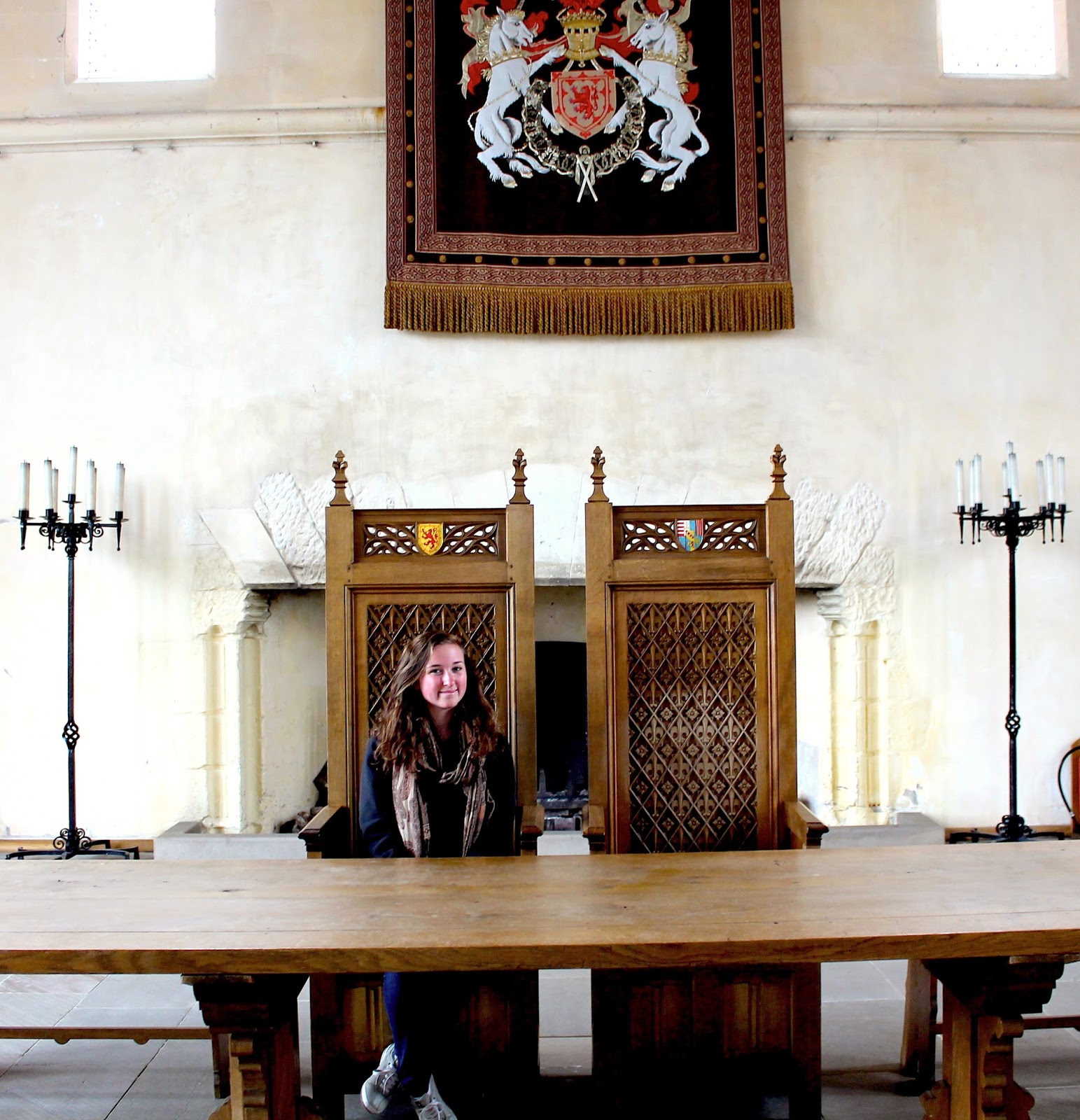
Chilling on the throne in the room where Mary Queen of Scots threw down
The most interesting part of the castle was that it was essentially completely restored to how it might have been in the 17th century and earlier. In fact, the castle had been used by the military up until 1964 which is when Historic Scotland began to restore it. So the inside of the castle was very cartoonish in its bright colors and restored decor. It was kind of an odd effect since it looked so new but was trying to replicate something so old.
An example of one of the restored rooms - check out that cartoon-like ceiling!
The biggest benefit of Stirling Castle, I think, are the views. It sits on a hill, so the views of Stirling were absolutely breathtaking.
After finishing up at the castle, Liam and I were left with about 3 hours until our train left. He was feeling very ambitious and somehow convinced me that we could go all the way to the Wallace Monument and back in time for the train - I was skeptical, but I'm very glad he convinced me. It was well worth the mile or so it took to hike there...and uphill, I might add.
The view of Wallace Monument from Stirling Castle
So we hiked across the river - yup, the very river that the English had to cross on the BRIDGE to meet William Wallace and the Scots at the Battle of Stirling BRIDGE. Did I mention it happened on a bridge? Silly Braveheart. Anywho, Liam and I crossed a bridge (not the bridge...remember, that one fell during the battle) near where the bridge once was and soaked in the historical moment. We found some monuments to the battle and made our way to the castle-like monument that commemorated it all.
Me on a bridge, not the bridge, near where the Battle of Stirling took place
By the way, the whole town of Stirling, unsurprisingly probably, is devoted to William Wallace and that battle. Something on nearly every block is titled "Wallace This" and "Wallace That" - which is quite charming actually. Again, a lovely representation of the differing identities of each Scottish city, but how each one fully embraces their identity.
Right, so we made our way to the Wallace Monument and ended up climbing to the very top. Guess how many steps there are? I'll save you the time, it's 273. Let me show you what the 273 steps look like:
Imagine climbing 273 of these tiny steps on a spiral staircase - if I didn't know what dizzy felt like before, I know now
The crazy staircase was totally worth the top though. Even though there was crazy amounts of wind and quite a bit of rain, the views from the top of the Wallace Monument were absolutely stunning, and the struggle it took to get there certainly made us consider the struggle Scotland has been through for greater independence and arguably still goes through today.
The Wallace Monument up close
As I said, the top of the monument is quite windy and a tad damp
The view from the top of the Wallace Monument
After our rather exhausting climb up and down the 273 stairs, Liam and I were ready to head home on the train and get back to our lovely warm beds in Glasgow.
The major plot point of this weekend was a rather exciting trip to the Highlands of Scotland to find Nessie! But before we could leave, we had a few lectures from our lovely Dundee Professors.
The first lecture on Friday was a lecture about theater and film from Dr. Jodi-Ann George and Dr. Brian Hoyle. It mainly focused on the play Macbeth, which unfortunately, I have yet to read. Even without much context, we were still able to grasp a lot of interesting information. Macbeth actually takes place in Scotland, something I probably should have known, but didn't. Macbeth, a real personhimself, plots to kill the Scottish king (in case you haven't read it either), and the castle is even based off Glamis Castle, which I visited earlier in the week. Anyway, Macbeth actually has inspired some fascinating questions about how to present Shakespeare. For instance, Orson Welles's film version originally was made with Scottish accents, but that was considered tainting Shakespeare, so it was dubbed over with English accents. The story is notably written for James I, a king particularly concerned with the concept of regicide (his own father having been murdered...perhaps by his own mother, Mary Queen of Scots) and also involved in legislation concerning witches and demonology - two major themes from the play. The other fascinating thing we learned from this lecture is a lesson of business. Apparently, thesbians were worried that people would be too depressed leaving the theater after a tragedy so they implemented a "stage jig" after the show to perk everyone up a bit. If you'd like to see an example, check out the following video:
The next lecture was the very anticipated Braveheart lecture(!) by Graeme Morton, one of our lovely Dundee hosting professors. We love Graeme. And his lecture included all the reasons why Braveheart is completely inaccurate, which is something people like to point out here quite often. Okay, let me set the scene for you. It's 1297 in Scotland, and William Wallace is quite put out at the English (surprise, surprise) and is fighting for the desired Scottish king, Robert the Bruce, or later, Robert I. Anyway, the Scottish men haven't worn face paint in battle in many many years (Braveheart Inaccuracy #1) so they approach Stirling Bridge with paint-less faces, ready for battle. Note that I said Stirling Bridge. Yeah, the real Battle of Stirling Bridge happened on a bridge (Braveheart Inaccuracy #2) and was a major factor in William Wallace's victory. The tactic used by the English that often brought them immense success was their ability to surround their enemy and attack from all sides; however, when they were fighting William Wallace and his men from across a river, their only access point was from a narrow bridge, thus, the Scots had an incredible advantage.
A bit north of the bridge pictured here is where Stirling Bridge was and the battle took place. As you can see, surrounding the Scottish men would be an impossibility for the English Army.
We actually know very little about the real William Wallace, which is part of the reason it's a little irritating that Braveheart didn't even adhere to the things we actually do know...but production value and stuff I guess. In fact, we only have one description of William Wallace, and the main feature is that he was quite large (Braveheart Inaccuracy #3...Mel Gibson is 5'8"). That description comes from an epic poem written by "Blind Harry" around 1475, almost 200 years after William Wallace's death. Our other source is the records from his trial, which essentially proved that he did in fact exist. Because we know so little about him, his story was romanticized throughout the years. One author in particular called Jane Porter contributed to this romanticizing of William Wallace with her book in 1810. Developments like this muddied Wallace's legacy shifting the focus from independence and Scottish nationalism toward more romantic motivations, which probably wasn't the case. Either way, the woman William Wallace is mainly involved with in Braveheart was either not even born yet or very very young at the time of the story in reality. (Braveheart Inaccuracy #4). There are more inaccuracies, but I'll get to them later.
After Graeme's awesome lecture, the squad headed for the Dundee train station, and hopped on a train to Inverness, the city of Loch Ness. It's about a 2 hour train ride north of Dundee. We all immensely enjoyed watching the Scottish highlands pass outside our large windows during the ride. The trains in Scotland, and probably the rest of the UK, have large windows and comfortable seats like a coach bus. They're spacious and even have tables sprinkled throughout each car. Our train ride there went very smoothly, despite a little trouble from the avian population while waiting for our first train. After our change in Perth, we were very excited to get to Inverness and check into our hostel, which wasn't even that sketchy.
Matt struggling with our one-legged pigeon friend
Perth Train Station, where our change was
So, we arrived in Inverness to find the same strangely large population of seagulls inhabiting the place. Did I mention the crazy amount of seagulls here? It's rather unfortunate. They're ever-present in both Dundee and Inverness so far -- perhaps Glasgow will be a different story. Anywho, after checking into our hostel, we decided to mosey around the city of Inverness for a while. You will be oh-so-surprised to know there's a castle in Inverness, but that wasn't our favorite part. There was a gorgeous walking path up and down either side of the river that the squad and I spent most of our night enjoying. They even had twinkle lights lining the path once it got dark enough, which does take a long time, mind you. One of the most difficult things to get used to up here in Scotland is how it doesn't really start to get dark outside until 10pm (or as they would say here in the UK, 22:00) and the sun doesn't even set until about 11pm (23:00). Military time has really been testing my basic math skills, let me tell you.
Inverness Castle and Matt
The boys at the beginning of our Inverness river walk -- apparently its called "Ladies Walk," though, so please do appreciate the irony in this photo; we work hard to be subtle
Most of us hit the hay after our river walk in anticipation of our trip to Loch Ness the next morning. As we waited for our bus at the Inverness, we made a few more avian enemies of the seagull variety but luckily we all made it onto the bus unscathed...or unpecked, I guess.
Jael, Daniel, Mike, Liam and Matt at the Inverness Bus Station
Loch Ness is about a half hour's journey from Inverness and drops you off at Urquhart Castle (pronounced urk-ket), right on the lakefront. Urquhart Castle is the ruins of a huge castle dating all the way back to the 13th century. It ended up being intentionally blown to smithereens by its current owner at the end of the 17th century to prevent Jacobites from using it as base or any of its resources during the wars of Independence. This presents an important aspect of the idea of Scottish Independence throughout the country's history. Not everyone was on board with the idea of independence, just like today. There were the Jacobites, who fought for a Scottish king and independence from England, but there were those who disagreed and were content with the Scottish relationship with England like the owners of Urquhart Castle. (Edit: since writing this, it's been pointed out to us that it's a misrepresentation of the Jacobites to consider the uprisings an England vs. Scotland issue and that instead, it's more of a Scotland vs. Scotland issue. This idea is perfectly demonstrated by the events at Urquhart Castle.)
Urquhart Castle with Loch Ness in the Background
Daniel, Mike, Me, Nina, Omar, Matt and Liam loving Urquhart Castle
My favorite part of Urquhart Castle was a man dressed in traditional Jacobite clothing of the 17th century who told us all about the weapons and clothes used by Jacobites during the wars of independence. As promised, he even told us about another Braveheart Inconsistency! One of the swords he showed us that was actually outdated by the time the wars of independence were taking place, is featured in Braveheart, which is okay because Battle of Stirling bridge was long before the wars of independence. The sword, a double-handed Claymore, is extremely long and quite dangerous. In Braveheart, good old Mel has the sword slung over his shoulder and is seen reaching up to grab it over his head. Well, as we know, Mel is a tad on the shorter side and such a maneuver would not be possible and such a sword probably wouldn't be either since it's probably longer than Mel himself.
Our Jacobite Warrior showing why the Claymore would not work for little Mel -- yes, his hand is demonstrating Mel Gibson's height
After Urquhart and our Jacobite lesson, we walked to a small cafe on a road near the Loch and had some lunch. We asked the owner of the cafe for the best way to the shores of Loch Ness, and she directed us to a rather offbeat path that passed a graveyard, some private farms and required trekking across a number of streams. It soon became apparent that it was a path usually used for horse trails due to the rather frequent occurrence of feces, but we didn't mind at all. The trail brought us directly to the shore of Loch Ness where several of us stripped down to swim suits and took a dip with Nessie (who was unfortunately unseen throughout our trip...but we're kind of in denial about that). It was a tad numbing, but at least the sun was out!
Crossing this lovely and only slightly frigid stream was part of our path to Loch Ness (photocred to Patty Esch)
Maybe we did see Nessie after all!
After Loch Ness we were all quite tired - we had hiked at least 5 miles, but probably more, the whole day. So we hopped on our bus and went back to Inverness where we split up for dinner. Patty, Michael, Tim and I tried "PizzaExpress" a chain here in the UK that is actually really good. Restaurants seem generally more health conscious here -- this chain restaurant offered broccolini as a side! What?! Patty, who is very passionate about vegetables, is very happy about this.
Our last day in Inverness was Sunday and we decided to take a trip to Culloden Battlefield. Of course, we soon learned that no buses go directly to the battlefield on Sundays, so we had to take a 2 mile walk to the battlefield after our short bus ride and could therefore only spend about 30 minutes at the actual site, but it was just enough.
Let me take a moment to talk about the Jacobites. I know I've touched on them before, but they are a rather integral part of Scottish history and identity. So, the Jacobites were a group of strong-willed Scots who adamantly supported the "rightful" king of Britain, James II and eventually opposed English rule of Scotland. The crowns of Scotland and England just happened to be joined in 1603 by chance since, as we know, Elizabeth I had no children and therefore no clear heir, James VI of Scotland was the most logical choice, therefore becoming James I of England. So, after the rule of James I, Charles I, the Glorious Revolution, Oliver Cromwell, Charles II and James II, when James II was rejected as king (he was Catholic) and his daughter and her husband William of Orange (notably not a Scot) were chosen as rulers of England (and Scotland) instead, many Scotsmen were quite peeved, and joined to form the Jacobites. Thus, the Jacobites supported James II as the true king of England and Scotland. Eventually, their mandate changed toward being against the union of Scotland and England all together.
Here's the Jacobite flag which we saw in the McManus Gallery and Museum. It has the St Andrews cross and a thistle. The thistle is the symbol that means you're doing the work of the king, so since the Jacobites supported James II's right to the crown, they figured they were doing the work of the true king. The words across the top read something along the lines of "don't mess with us," quite fittingly I might add.
Anyway, the Battle of Culloden was a decisive and extremely devastating battle of the Jacobite Uprisings between the English army and the Jacobites on April 16th, 1746. Note that this is after the joining of the Scottish and English parliaments into the British parliament (1707), so the country continued to move toward union even after Jacobite protests. It should also be noted that there were also religious tensions contributing to the Jacobite-English conflict. The Jacobites supported James II, a Catholic king while the English obviously embraced Protestantism as would their next King, George II of the Hanover household. The Battle of Culloden resulted in huge amounts of casualties for the Jacobites. The English were absolutely merciless and even after the battle had been won decisively, continued slaughtering the Jacobites. Ultimately, this resulted in three things: 1) the end of armed conflict for Scottish independence 2) the banning of and attempting to wipe out highland culture 3) a legacy of hatred between England and Scotland that fluctuated throughout the countries' history. This battle is an important moment in Scottish history that is still poignantly felt by the Scottish people, which is made clear by its emphasis throughout our program and the thoroughness of the site to this day.
Culloden Battlefield - the red flag marks where the British line began
"Field of the English; They Were Buried Here"
The squad at Culloden Battlefield
After Culloden, we had to rush back to catch our bus back to Inverness and then we putzed around town for a few hours until our train back to Dundee. We were all quite happy to return to our happy little town of Dundee, especially Patty and Michael who missed the connection in Perth on the way back.
Thus, the squad and I learned a ton about Scotland on our trip to Inverness, even without the amazing lectures we get during the week here in Dundee.