Showing posts with label Mary Queen of Scots. Show all posts

Thursday, July 30, 2015

History and the law, the Necropolis, and the BBC

Firstly, I'd like to apologize for the lack of creativity in the title for this blog post. I simply could not find an alliterative way to sum up it all up.

Alright, so on Wednesday, we had a massively informative and critical lecture for our understanding of Scotland. Although it was titled "Scotland's Legal Tradition," our lecturer, Dr Kenneth Norrie, took us through 1,000 years of Scottish history to illustrate the impact of the country's legal tradition. As a history major, this made me incredibly happy. Having the historical context is extremely necessary in order to fully understand any subject! So unfortunately for you, I'm going to quickly summarize the important and interesting points of Scottish history that Dr Norrie noted because I felt this sped-up version of Scottish history allowed me to begin to put together the puzzle pieces of what we have been learning thus far (the Jacobites, Mary Queen of Scots, William Wallace, etc.).

So, let's go back to medieval times! Weee! It's the 10th century, and the area we know as Scotland is kind of a conglomeration of Celtic (Britons and a lot more), Irish (Scots) and Germanic (Angels) tribes. Eventually they all get unified under one dude (classic) named Malcolm II (king of the Scots tribe). So, there was a bit of an awkward clash of tradition when Malcolm II united all these tribes that literally set in motion the rest of Scottish history (cue dramatic music). See, Celtic tribes are matrilineal, that is, they trace their family line through the mother, not the father. So succession depends on the maternal line - therefore if a king dies, his successor has to be the closest related to the mother, so his brother would take over, not his son. If you think about this, it makes way more sense to trace lineage through the female; you know why? Mothers always know who their children are and fathers...don't. Right, so Celtic tribes are matrilineal and the Scots, the Irish one, is your classic patrilineal (tracing family lines through the father). Now we're gonna have a quick vocabulary lesson: using patrilineal succession is called Primogeniture and matrilineal is Tannist. Good? Good.

 Well, when Malcolm II unites all these tribes and he's Scots, when he dies, they use the system of Primogeniture, and the crown is passed to his grandson, Duncan I. That's all good and well, unless your name is Macbeth. Oh my gosh, Macbeth! Shakespeare wrote about him! Yeah! He did! This moment is what he wrote about! Alright, so, Macbeth was Celtic, but he was also the son of Malcolm II's daughter. So, being Celtic and more down with the Tannist (matrilineal, remember?) tradition, Macbeth was like, "Duncan I is a usurper of my throne" and thus killed him in battle. He installed himself as King and ruled quite well actually, however, Duncan's son Malcolm (spoiled: soon to be Malcolm III) was thinking "...wait, Macbeth totally usurped my throne," since he believed in Primogeniture. So Malcolm killed Macbeth in battle and became Malcolm III. By the way, Malcolm III married Queen Margaret, a Saxon princess, who was responsible for bringing the importance of the (Christian) Church to Scotland and also for beginning the decline in Celtic influence.

Malcolm II (thanks for the photo wikipedia!)

How are we doing? Too much history? Too bad - there's more!

Okay, skip ahead to 1290. The monarch (a wee babe), Margaret, dies and (obviously) has no heirs! There are two possible choices: Balliol or Bruce (Yeah! Robert the Bruce! We know him!) Balliol had a claim to the throne through primogeniture; Bruce had a claim through the Tannist succession. BUT they couldn't work it out. So, they submitted this issue to Edward I of England and forever changed Scottish history. THIS WAS A BAD IDEA. By asking Edward I to choose Scotland's next monarch, Scotland implied that England was superior to Scotland and had some sort of authority over it. This implication would affect Scotland for the rest of its existence up until this very day.

Edward I (thanks for the photo wikipedia!)


So, Edward I basically tells both Balliol and Bruce if they accept England as their feudal overlord of sorts, they can be King of Scotland. Bruce was like "heck no!" and Balliol was like "yeah, whatever, okay!" so Edward chose him. Thus the wars of Independence between the Edward I of England vs William Wallace and Robert the Bruce! Woohoo connections!

Also, remember that Declaration of Arbroath thing? The thing that may have had a role in inspiring our own Declaration of Independence? Yeah, that was in 1320, right? And Robert the Bruce is the one who sent it (it was a letter to the pope) in which he essentially declared that Scotland was independent from England, the Pope himself (more or less...they remained Christian for over 200 more years), and that the people were sovereign. Not him, Robert the Bruce, the people. This is why after 1320 you never again see any monarch in Scotland called King/Queen of Scotland - they're the King/Queen of Scots (the people). Hench Mary Queen of Scots. Cool, huh?! Scotland is super progressive.

Here's the Declaration of Arbroath again! Well, a copy of it :)


So, wars of independence distance Scotland from England, naturally. But this applies to many areas like trade and also law. Scottish lawyers begin to train in Scotland and Continental Europe and adopt a more Roman style of law which sticks with them throughout their earlier history. In fact, this is essentially the reason Scotland has a separate legal system from England even today! In the 15th century, Scottish parliaments are sitting regularly and they even pass the Education Act of 1496 demanding education! Even though this education is for the eldest son of landowners, it's still really progressive for the 15th century!

Okay, the Reformation happened and changed Scotland completely in a bunch of ways, but I think I've talked about the reformation enough in this blog, so I'll skip it. You're welcome.

The next fun fact to do with Scottish law has to do with that young 1707 Union - the joining of the parliaments. So, according to Dr Norrie, if you ask an English lawyer about the 1707 Union, he/she will say that the English parliament expanded to allow Scottish representation, which is technically correct, that's what happened. However, if you ask a Scottish lawyer, they will say both the English and Scottish Parliaments dissolved and a parliament of Great Britain was established, which is politically accurate - that was the agreement essentially. If you recall, I actually wrote the latter statement in a previous blogpost because I heard it in a lecture from a Scotsman! Cool stuff. Also, the Treaty of Union notably provided for the preservation of Scots law and the primacy of the Presbyterian church!
How did that happen? (ugh, I'm sorry guys, but this was a really great lecture and it's all so important to truly understanding Scotland) Sir James Dalrymple, First Viscount of Stair (quite the name, if you ask me, but apparently, Scottish lawyers today just call him Stair) wrote the first comprehensible book of Scottish law! His book was so comprehensive and legitimate that it allowed Scottish law to be recognized by the English in the act of Union! Good job, Stair!

Sir James Dalrymple, First Viscount of Stair! (thanks for the photo, stairsociety.org)

Alright guys! Thank you for bearing with me! That's it for the dense history.

Okay, Wednesday night Patty, Liam and I explored the Necropolis (!) - Glasgow's central and very famous cemetery. As you may be able to figure out, Necropolis means city of the dead, and it is just that. The gravestones, like buildings, are lined up in very meticulous rows creating sidewalk-like paths for viewers. It's a very creepy place, honestly, especially since we visited at dusk. Really interestingly, though, Liam came across two gravestones for both sides of his Scottish ancestry practically right next to each other!

Patty and I at the Necropolis Entrance

Me with the John Knox monument at the top of the Necropolis!

The Necropolis and a lovely view of Glasgow

Thursday proved to be a very exciting day as well. It was completely media-focused and ended with a trip to BBC Scotland!

So our lecture was all about the media in Scotland and it was all very eye-opening (as usual). Our lecturer was Dr Michael Higgins and he began his presentation by trying to explain how Scottish culture is all about disagreement and arguments and further, that there are few things that unite Scotland. This statement alone was so new, but yet so obvious to us all after being here for four weeks. This is a good time to talk about the dynamic between cities in Scotland. All the major cities love nothing more than to rip on and make fun of each other. It's not always very nice either. Aberdeen and Dundee have a kind of intense rivalry as well as Glasgow and Edinburgh. That's not to suggest that Glasgow isn't just as willing to throw a few jabs at Dundee or Edinburgh at Aberdeen. The way the media is structured adds to this dynamic, if anything. Dr Higgins showed us several different newspapers that had associations with cities. So, each of them would write from a different perspective - from the particular city's perspective - which could be drastically different from another city's perspective. So, for instance, The Herald writes the Glaswegian perspective while The Scotsman writes the Edinburgh perspective.

The Scotsman itself!


Dr Higgins also noted how newspapers are one of the ways Scotland makes itself distinct from England. For instance, many English newspapers have Scottish Editions like The Sun has The Scottish Sun so these newspapers are slightly more geared toward Scottish audience and perspective (what those in the media affectionately refer to as "putting a kilt on it." Sometimes it's not so slight though. During independence, one newspaper printed one edition that advocated a "no" vote and the same newspaper advocated a "yes" vote in the Scottish edition! What the heck? It's a crazy place here in the U.K.

The group and Dr Higgins after our lecture on the median in Scotland

Another interesting part of Dr Higgins's lecture was in discussing how the BBC works. As you probably know, the BBC is funded by the public, not a private corporation in order to provide truly quality content that is not necessarily economically profitable. So, as I thought before and as you might think, the BBC is not funded by taxes, it's funded by a "TV License." A TV License is essentially how if you own a TV, you have to buy a TV license and all the profits from a TV license go toward funding the BBC. That way, if you don't have a TV, you're not funding a service you don't use.

The last notable thing about the media in the UK? They watch Fox News for entertainment purposes. Like, to laugh. I just thought that was quite hilarious in itself.

After our media lecture, we (very appropriately) went to visit the BBC Scotland! We learned a lot about how the BBC and the freedom of the press in general works. One interesting and important tidbit is that the BBC is independent from the government (which makes sense since it's not funded by taxes) but still works closely with the government. It's Royally Chartered, which means the charter can be reviewed every 5 years. Some updates BBC Scotland is looking toward include new ideas for funding online TV watching (something comparable to a TV license perhaps?) among other issues. Scottish Independence, for instance, if revisited could change a lot about BBC Scotland, obviously, so far as the country could lose its association with the BBC all together and have to create its own public broadcasting system if it so desires. It's all very fascinating. Independence has so many implications that fly completely under the radar.

Getting ready to go inside BBC Scotland

We also learned a lot from Donald Martin, Editor in Chief at DC Thomson (Based in Dundee! Remember?) about the restrictions and regulations on the press along with ethics in reporting certain issues. He faced us with a lot of important questions on whether to print certain pictures and stories and why. It was all very fascinating. I can't possibly detail it all here, but if you're interested, let me know and I'll be happy to expound.

After learning all this amazing information about media, we got to go on our own tour of the BBC Scotland. My favorite part was probably the metallic gold pair of underpants that hung from a pole at one of the cubicles. When a journalist was asked by our tour guide what it was doing there he replied "they're drying" without blinking an eye. Anyway, we got to see a lot of the studio and even got to watch an anchor record part of that night's show! It was an amazing experience.


Us in the Newsroom at BBC Scotland

Look, Ma, I'm on TV!

The squad on our BBC Scotland tour

Thank you for bearing with this post through all the (super fun and interesting!) history! I promise the next one won't be so dense. Cheers till then!


Monday, July 27, 2015

Sunshine, Stirling, and Stairs

Saturday was sunny! Nearly all day even! Which was lucky for us since we spent a lot of it outside.

We met John outside our flats Saturday morning for a walk through a new part of Glasgow. We walked down High Street getting bits of Glaswegian history along the way and eventually came to the Glasgow Green. The Glasgow Green is one of my favorite places in Glasgow so far. It's a large park made up of huge fields of grass, elegant lines of trees, and several historical monuments. However these monuments weren't all for war heroes and politicians - they were for more localized citizens and popular movements specific to Glasgow. There was even one for those who opposed the first World War, which I thought was especially fascinating. My favorite monument was to the women of the Temperance Movement given the irony of temperance in a country with such an emphasis on drinking in its culture.


The monument to the Temperance Movement in Glasgow Green
The Glasgow Green also shares a space with something called the People's Palace, another testament to the importance of the people themselves to Glasgow's identity. The People's Palace is a rather small museum devoted to the history of the people of Glasgow themselves. The exhibit details marriages throughout Glaswegian history, what school was like, the Temperance Movement, what jail was like, a favorite dance, homosexual history - it was all a lovely testament to the identity of Glasgow. The people of Glasgow are so embraced by their own city that the city's slogan itself is "People Make Glasgow" - which as Neil (our student ambassador) pointed out to us, is quite brilliant since you can add any word to the end of that phrase as well such as "People make Glasgow...musical" or "smart" or "beautiful" etc.

The People's Palace - quite literally named, clearly


The Commonwealth Games (an every four year sports affair at which all British Commenwealths, including former ones, compete against one another) were held in Glasgow last year, and this was their mascot, Clyde. He serves as another example of Glaswegian identity and pride. 


Outside the People's Palace is a lovely Terracotta Fountain (the largest in the world actually!) called the Doulton Fountain. On top sits Queen Victoria looking out on her empire. This domineering statue of Queen Victoria is all over the city and apparently was erected during Britain's imperialistic moment in history as a symbol of the empire. Part of me wonders what would happen to these imperialistic images if Scottish Independence were to occur - but another part acknowledges that Scotland deeply values its history, and would probably keep them in place as a testament to their past and the massive legacy of English rule they had to overcome to be independence.

All of us outside the Doulton Fountain

After the People's Palace we got some lunch at a lovely pub nearby that supposedly sold the best beer in Glasgow - ironically it's German beer - but the food was certainly lovely.

After lunch, Neil brought us to the Merchant City Festival. We are so lucky to be in Glasgow for this festival. It is such an excellent representation of Glaswegian culture. Everyone is out and about on the streets looking in on the booths that are all completely decked out with either delicious deserts, crazy food, or little Scottish trinkets. I have never seen a more extensive street festival in all my life. We all had a lovely time exploring and talking with the vendors, trying amazing deserts and enjoying the musicians on the street. By the way, every single time we've been on the streets of Glasgow, there's always a street musician playing. From all ages and all types of music, there hasn't been one time without music - a lovely testament to the artisticness and creativity that is bursting from this city through every outlet whether it be music, film or theatre.

The Merchant City Festival in Glasgow

I was super excited to see the spread at the dessert booths - who knew Turkish Delight was actually delightful?

Although the music and the festivals are pretty grand, there is one thing I love even more about Glasgow - the police boxes. People, the Doctor could land the TARDIS in this city and no one would find it even remotely out of place. There are police boxes of every color throughout the entire city, although I like the blue ones best.

Me with a green TARDIS

Me with THE REAL TARDIS - shame on all the nonbelievers


After spending hours exploring the Merchant City Festival, we headed home to get some rest.

On Sunday, we all kind of split up and did our own things. History nerds as we are, Liam and I decided heading to Stirling was our top priority. As you might recall, Stirling is the location of the ever important Battle of Stirling BRIDGE - that's right Mel Gibson, the Battle of Stirling BRIDGE was on a bridge. Of course, it fell during the battle, so it's no longer there, but we were super duper close to where it was! By the way, all the Braveheart debunks are on a previous blog post - do take a peak if you haven't already. It's important.

Right, so Liam and I took a quick train to Stirling and were quickly smitten with the small town. It's quite historical. It even has little blue and gold signs throughout the whole place explaining the historical significance of old churches, buildings and bridges. Naturally, we loved that. We were a tad hungry when we arrived, and happened upon LORD DARNLEY'S HOUSE. If you don't recall, Lord Darnley was Mary Queen of Scots's second husband -- you know, the one that flew into murderous rages on occasion and killed David Rizzio in front of his very pregnant wife that one time. Good stuff. Anyway, it's casually been turned into a coffee house aptly titled "Darnley Coffee House." Naturally, Liam and I chose this place to stop for a bite. It was quite small with a couple decently sized rooms and the characteristic short doorways. It was a perfect start to our history-filled day.

The Darnley Coffee House - Lord Darnley's actual house


After our lunch, we headed up a hill and happened upon an awesome-looking church. Classic Scotland. We peaked inside and discovered it is the Church of the Holy Rude which Mary Queen of Scots worshipped in and John Knox preached in! We were tweaking with excitement.

Church of the Holy Rude

Inside the Church of the Holy Rude

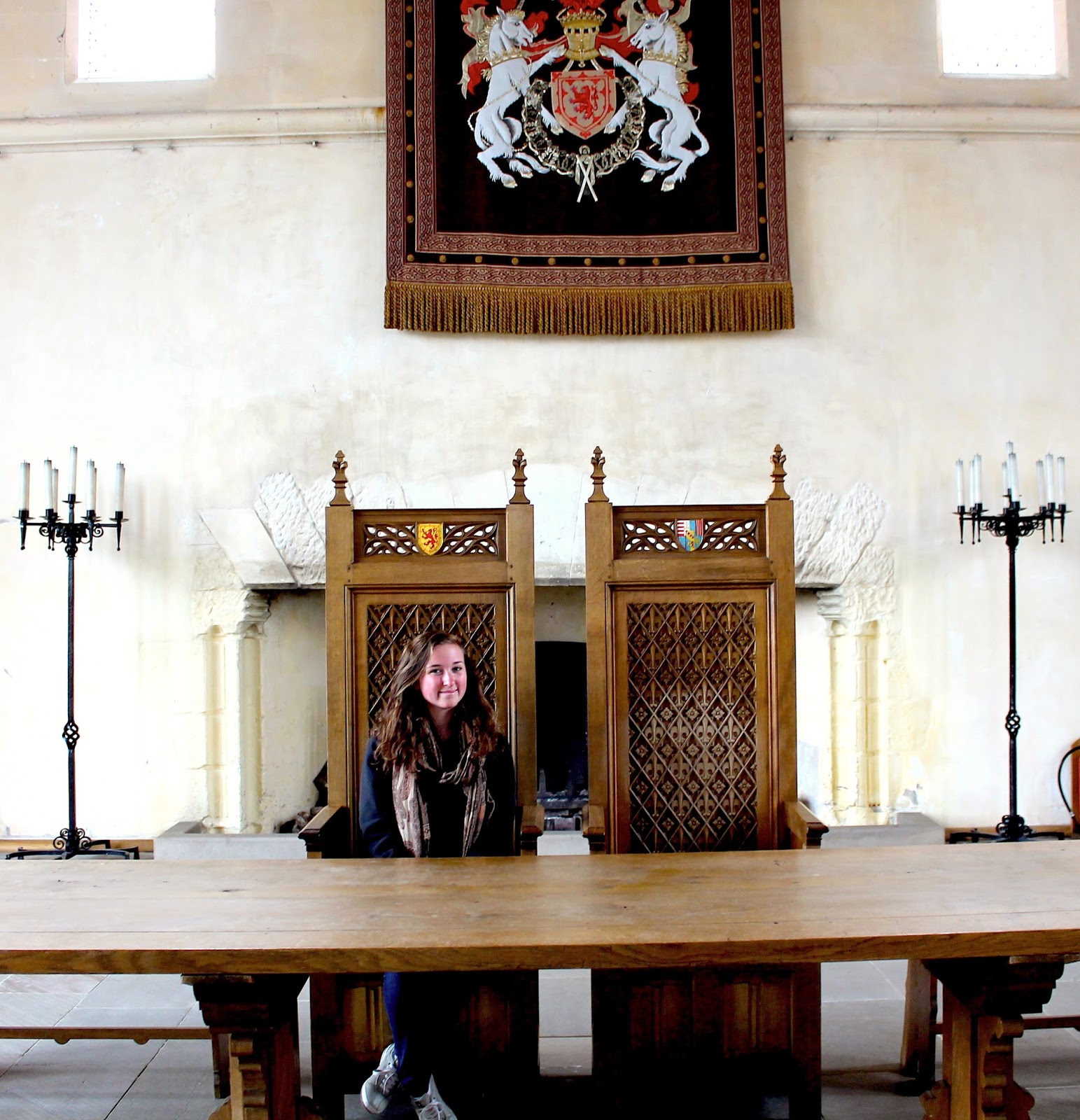
After poking around the Church, we walked up the road to Stirling Castle itself. Wow, there was a lot of history in this building. It's been sieged 16 times - half of which are by the English and the other half by the Scottish trying to take it back from the English. It's switched hands between the two many times and it's all rather confusing. Mary Queen of Scots along with several other important royals had been baptized in that very church and many of the James's (James V, James VI/I etc.) lived there as well! The decor was fantastic and we really loved our tour guide. He liked his sound effects - especially shouting "BOOM....BOOM BOOM!" when discussing castle sieges. My favorite part was a huge room they call the "great hall" used to host parties by the likes of Mary Queen of Scots herself. Our tour guide told us that she once hosted a three day party that required her to take out the equivalent of 12 million pounds in that very room.

Stirling Castle

Stirling Castle

Chilling on the throne in the room where Mary Queen of Scots threw down


The most interesting part of the castle was that it was essentially completely restored to how it might have been in the 17th century and earlier. In fact, the castle had been used by the military up until 1964 which is when Historic Scotland began to restore it. So the inside of the castle was very cartoonish in its bright colors and restored decor. It was kind of an odd effect since it looked so new but was trying to replicate something so old.

An example of one of the restored rooms - check out that cartoon-like ceiling!
The biggest benefit of Stirling Castle, I think, are the views. It sits on a hill, so the views of Stirling were absolutely breathtaking.

After finishing up at the castle, Liam and I were left with about 3 hours until our train left. He was feeling very ambitious and somehow convinced me that we could go all the way to the Wallace Monument and back in time for the train - I was skeptical, but I'm very glad he convinced me. It was well worth the mile or so it took to hike there...and uphill, I might add.

The view of Wallace Monument from Stirling Castle
 So we hiked across the river - yup, the very river that the English had to cross on the BRIDGE to meet William Wallace and the Scots at the Battle of Stirling BRIDGE. Did I mention it happened on a bridge? Silly Braveheart. Anywho, Liam and I crossed a bridge (not the bridge...remember, that one fell during the battle) near where the bridge once was and soaked in the historical moment. We found some monuments to the battle and made our way to the castle-like monument that commemorated it all.

Me on a bridge, not the bridge, near where the Battle of Stirling took place


By the way, the whole town of Stirling, unsurprisingly probably, is devoted to William Wallace and that battle. Something on nearly every block is titled "Wallace This" and "Wallace That" - which is quite charming actually. Again, a lovely representation of the differing identities of each Scottish city, but how each one fully embraces their identity.

Right, so we made our way to the Wallace Monument and ended up climbing to the very top. Guess how many steps there are? I'll save you the time, it's 273. Let me show you what the 273 steps look like:

Imagine climbing 273 of these tiny steps on a spiral staircase - if I didn't know what dizzy felt like before, I know now
The crazy staircase was totally worth the top though. Even though there was crazy amounts of wind and quite a bit of rain, the views from the top of the Wallace Monument were absolutely stunning, and the struggle it took to get there certainly made us consider the struggle Scotland has been through for greater independence and arguably still goes through today.


The Wallace Monument up close


As I said, the top of the monument is quite windy and a tad damp

The view from the top of the Wallace Monument

After our rather exhausting climb up and down the 273 stairs, Liam and I were ready to head home on the train and get back to our lovely warm beds in Glasgow.

That's all for now! Cheers till the next one :)


Friday, July 17, 2015

Fun in Edinburgh, Forensics and Faces


It's beginning to shock me that I can write unfortunately long blog posts about the activities over only two days, but that is the nature of this amazing and busy trip through the Fulbright Commission. Our day in Edinburgh on Wednesday really captured exactly how much the Commission intends to expose us to in such a short 5 weeks.

So, the group and I woke up bright and early to hop on our bus to Edinburgh on Wednesday morning. Once we arrived, we ate breakfast in a small cafe and waited for Leo, one of our Strathclyde contacts, who was spending the day with us. As soon as he arrived, we jumped immediately into our busy schedule.

The first part of our trip to Edinburgh was climbing Calton Hill. Calton Hill has the most amazing view of Edinburgh and is one of the more touristy spots. When you google the city, images from Calton Hill will undoubtedly pop up, and it's really not hard to see why - the view is stunning. Leo and Pat, our Dundee Professor who joined us, pointed out several important parts of Calton Hill and places in Edinburgh since we could see a huge part of the city from the top. We snapped several photos, but soon had to move on to our next activity.

This is the rather classic view of Edinburgh from Calton Hill - it's absolutely stunning

Here's most of the boys and Leo by the National Monument of Scotland on Calton Hill

The Nelson Monument on Calton Hill

Me on Calton Hill with the famous landmark, Arthur's Seat, in the background

Our next stop was the National Portrait Gallery. The group and I highly enjoyed just walking the streets of Edinburgh with gorgeous buildings, bag pipe players, plenty of gift shops and beautiful scenery, all the while with Pat and Leo telling us anecdotes about the city. The Portrait Galley itself was stunningly beautiful, of course, just with the architecture let alone the portraits. Anyway, we were led into this rather small room filled to the ceiling with books. I won't lie, I was almost more excited about the structure of this room with the two floors of books than the amazing and famous photographs we were about to be shown. Anyway, we got a lovely presentation about the evolution of photography over time by Anne Lyden, an international photography curator. She told us about how Scotland made a crucial contribution to advancements in early photography mainly through the work of Hill & Adamson who used paper as their medium instead of highly shined metal, and therefore taking important steps in the new industry. Other highlights are below:

This here is Queen Victoria and her footman Mr. John Brown. You may have heard that after Victoria's husband, Albert's death she was notoriously close to Mr. Brown (there was a film made about it rather recently) and this photography was used to highlight their suspiciously close relationship. What one might not immediately notice is that the original photograph features another footman standing right beside Mr. Brown, but he was cut out of the photograph for sensationalizing purposes. 

So, this is a photo by Alfred Buckham who was a pioneer in photography due to shots like these from high altitudes. Apparently he would just hang right out of the planes by his leg!

You might recognize these four gentlemen - they're the Beatles photographed by Harry Benson, still a rather famous photographer 

This the main hall of the National Portrait Gallery in Edinburgh - clearly everything is beautiful in this building, not just the portraits. 


After our photography lecture at the National Portrait Gallery, we walked briskly through Edinburgh to our next appointment with the British Council. You might be thinking "what in the world is the British Council?" - I know I was - but apparently, a lot of Britain itself doesn't know either. The British Council is a nondepartmental government body that works to use the cultural assets of the United Kingdom to build trust and positive relationships between the people of the U.K., and other peoples overseas. It was emphasized that the British Council is all about the people-to-people relationship, not involving the governments necessarily. Also, cultural assets is a bit of an arbitrary phrase, but our host, Kate Walker, gave us the examples of the U.K.'s exceptional education, arts, and english as a language. Now, my sister, having her degree in cultural anthropology, and having taken anthropology classes myself, there were some red flags going off in my head concerning cultural respect of other nations, but after asking a few questions, I found myself gaining high respect for the British Council and all the amazing work it does. The people who work there generally have worked abroad and have a level of cultural experience along with the cultural training they get when they begin working for the Council. But more than that, wherever the Council is doing work, whether it be Afghanistan, or Beirut or even the U.S., they usually heavily rely on the advice and cultural understanding of the local population and usually have a team of locals working alongside them.

So what exactly does the Council do? Well, our host mainly talked about their efforts in education across the world. One example she used was their work in South Sudan where they were particularly focused on female education achievement. There's so much more to say about the British Council and the amazing work it does, so if you'd like to know more, let me know and I'll be happy to extrapolate.

The group and our host, Kate Walker, at the British Council office in Scotland

As if we hadn't already had enough amazing experiences for one day, we moved on to our tour of the Scottish Parliament. Oh man, I have so much to say, but I'll try and keep it brief. So, the Parliament of Great Britain (you know, that thing at Westminster), devolved some power to Scotland beginning in 1997. Wait, wait, wait, remember that date 1707? That's when the Scottish Parliament and the English Parliament were dissolved and merged into the Parliament of Great Britain. So, that covered the legislation of England and Scotland from 1707-1997 -- which is quite a long time! Alright, so Scottish Parliament - the building itself wasn't actually opened until 2004, which does not surprise me having been in it. It's a bit of a masterpiece. So we come in and put our special pink lanyards over our heads to show everyone we're special and then start our tour. The architecture was very modern and quite stunning, but also had a lot of important symbolism. For instance, the St Andrews cross (the cross on the flag of Scotland and therefore a completely secular symbol) could be seen in all sorts of creative places from the ceiling to the floor -- quite literally. It was made almost entirely from oak wood as well, giving it a very warm feeling.

St Andrews crosses on the ceiling of the Scottish Parliament

The lobby of the parliament is a perfectly public place anyone can come in and use!

This is the debate chamber in the Scottish Parliament - talk about gorgeous

The sun roof of the debate chamber in the Scottish Parliament

On of the hallways inside - the ceiling is supposed to look like leaves 

One of my favorite moments of the tour was the tapestry pictured below that was made to symbolize Scottish history. At the far left, it's all black with a few Scottish flags representing the distant past of Scotland and all the stories and moments that are shrouded in the doubt of the deep past. Certain crosses throughout the tapestry represent certain things; so white represents a unifying event, and black symbolizes an event with lots of death and loss. There are also hidden messages in block letters, which, of course, I can't remember, but they referred to Scottish nationalism.

The tapestry of Scottish History

After our tour, we were lucky enough to get a chance to sit down with a current member of the Scottish Parliament (MSP) called Jenny Marra. Ms. Marra is a member of the Labour party's shadow cabinet in the Scottish Parliament. As you may know, the Labour party in Scotland has recently met a huge obstacle in representation in the Parliament of Great Britain due to the success of the Scottish National Party (SNP) - out of the 59 seats Scotland holds at Westminster, Labour won only one of them, while the SNP won 56.

My question for Ms. Marra was what some of the reasons are for the discrepancy between independence being voted against last September and then the Scottish National Party winning the vast majority of seats in the British Parliament in the most recent election in May. As expected, Ms. Marra had many interesting insights. As many know, independence was voted down last September 45 to 55. One of the more interesting tidbits was how those who voted "yes" for independence are referred to as "45-ers" because of the voting record. Interestingly enough, the number 45 has had significance in the realm of Scottish nationalism for a number of years, namely because of 1745, the year of the Jacobites' Battle of Culloden. Ms. Marra also noted that the 2-year campaign for independence was very similar to President Obama's first campaign in that they both emphasized hope and change. Anyway, Ms. Marra made sure to mention that she, being a member of the Labour party, does not support independence and was instead part of the "better together" campaign.

 In considering the inconsistency between voting against independence and the bounce back of the SNP in the general election, Ms. Marra said some level of bounce back was expected, but not nearly the amount the SNP gained. So why was the SNP so successful? According to Ms. Marra, the SNP knows how to run a good campaign. For the referendum, the party was successful in lobbying for and achieving a lower voting age, considering that younger people were more likely to vote for independence. However, Ms. Marra said that when polls were taken across Scotland in schools, the proportion of those who wanted independence and those who didn't were about the same as those of the general election, so although these efforts might not have helped the odds of independence much, it still catalyzed the voting age in Scotland to be lowered to 16 for electing members to parliament and in referendums. One reason Ms. Marra stated for why the SNP was able to make such a splash in the last general election is the leadership of Nicola Sturgeon. Besides her general appeal and excellent political skills, Ms. Marra suggested it is a popular time for female leadership as well. One particularly brilliant move on Ms. Sturgeon's part was pitting the SNP against the Conservatives, not Labour, in the general election. Labour is a more liberal party than the Conservatives (unsurprisingly), so Sturgeon was able to create a duality with greater polarity in the general election by contrasting her party with the Conservatives.

The group of us talking to Jenny Marra in the Scottish Parliament

It was very interesting being able to talk to a member of the Scottish Parliament in the Labour party about the SNP and the independence referendum. Based on interactions the locals, at least in Dundee, I've really only been exposed to the perspective for independence. Although, Ms. Marra did mention that Dundee is considered a "yes" city, so perhaps Glasgow will present a different perspective. More on what the locals have to say about independence later though.

So, in order to relax a little after our thrilling time at the Scottish Parliament, we crossed the street and toured a castle for an hour (relax, ha). Not just any castle though, the Queen's Scottish Residence, Holyrood Castle (pronounced Holly-rude). It was named after the Abbey that stands in ruins next to it which once supposedly housed a fragment of the cross Jesus was crucified on (holy + rood, which was an Old English word for cross), but our tour guide suggested that was probably just something they said to entice early Christians to take pilgrimages to the abbey.

Holyrood Abbey - right next to the castle

Anywho, Holyrood was very crowded and touristy - more so than any castle we've seen. It was very lavish, of course, and our tour guide was able to tell us of many impressive occasions and moments that occurred - and still occur - in the castle such as the knighting of Sir Sean Connery. The most impressive part of the castle, for me at least, was Mary Queen of Scots's bed chambers. Our tour guide told us a rather chilling story of the room where one of Mary's personal secretary and good friend, David Rizzio, was suppering with Mary with a few other friends in her chambers when Mary's paranoid second husband Lord Darnley barged in with a group of Protestant nobles, dragged Rizzio out of the supper chamber across a room, and proceeded to stab him no less than 56 times. Talk about excessive. Oh, and Mary was 6 months pregnant.

Here's a portrait of the Murder of David Rizzio, although a) Mary does not appear to be pregnant and b) that room is not that big, let me tell you
The courtyard at Holyrood Castle

The whole squad outside Holyrood Castle

Think our day in Edinburgh is over? Not even close! Next we hopped in a taxi and headed to the U.S. Consulate. It was casual - not. We changed into our finest garmets in order meet with the staff at the U.S. Consulate in Edinburgh and a U.S. diplomat, Fleur Cowan, currently stationed in London, but working on relations in Iran. It's very complicated.  We had a lovely meet and greet with Ms. Cowan and the other staff members and were able to ask her what it was like to work in the foreign service. Ms. Cowan has spent time in various countries serving the United States and speaks seven languages. She walked us through a normal day as a diplomat, mentioning how important collaboration and staying up to date with politics is for their team. Between this visit and the British Council, I'm confident many of us were considering a potential future in the foreign service.

The group with Fleur Cowan, U.S. diplomat

After our visit with the diplomats, we stayed at the consulate for a reception that hosted people from all over Scotland. There were several students and Professors from both Dundee and Strathclyde along with high school students who were interested in studying in the States. My favorite conversations were those with the younger high school students. They told us we had accents and couldn't believe we were so excited to be in Scotland. They also were flabbergasted that we had yet to try Tablet (a harder, carmel-y fudge), Haggis and Irn Bru (pronounced Iron-Brew), which I went out and tried today since they insisted it was very tasty. It's not. It's less sugary soda that tastes like bubblegum cough syrup, but at least I tried it, right?

Here I am trying Irn Bru, the Bubblegum Cough Syrup Soda in the Dundee Student Union

So, after our day in Edinburgh, we were exhausted, as you might imagine. We all slept quite well Wednesday evening and were well rested for our day of Forensics!

On Thursday, we spent an amazing 7 hours in the Forensics department at the University of Dundee. There were three main highlights. Firstly, in our opening lecture, Dr. Clare Lamb discussed one of the most important advancements in the study of anatomy, Thiel Embalming. This method of preservation of the human body leaves tissue soft and much more lifelike, so that observations and experiments are significantly more accurate to the live human body. But get this, Dundee is the only university in the UK that offers instruction in Thiel Embalming and the technique isn't used at all in the States. What?! This is the best way to preserve the human body and study anatomy out there and the U.S. isn't using it? We couldn't believe it. When asked why this is, Dr. Lamb had a depressingly simple explanation: most of the literature on it is in German. Sure, there are costs associated with it, but the research advancements are totally worth it, especially with all the crucial medical research done in the States. My own sister actually works for a translation company, so I made sure to tell her to get on that.

The second highlight was being able to see and touch body parts preserved with Thiel Embalming vs. the older method (which basically plasticizes and hardens all tissue for preservation), which effectively demonstrated the assets of Thiel Embalming. Yeah, it was little eerie to hold a human heart in my (gloved) hands and manipulate a dead hand's tendon to make the finger move, but it was clear that preserving tissue in its soft state would lead to much easier and effective medical research. Plus, our bio majors Patty and Nina were tweaking with excitement, which is always fun to see.

The final highlight of our day of Forensics was the facial reconstructive portion. Dr. Christopher Rynn walked us through the process of facial reconstruction and how it's evolved over time. Dundee's facial reconstruction services are used for several criminal cases a year and for many other services as well. Although the scientific portion of the lecture was absolutely fascinating, my favorite part was when Dr. Rynn discussed race and facial reconstruction. He told us about how the "Cross-Race Effect," or basically how if you're a member of one race, you might think everyone from another race looks very similar, is rooted in skulls and psychology. Because when we see another face, our brain automatically compares it to our own, we're used to comparing differentiating features that result from our own skull shape - so for me, I look for differentiating factors that result from a caucasoid skull. Because people of Asian decent (and Native American, actually) all have mongoloid skulls, that's the main distinction I, as a caucasoid, see. So I might think most Asian people look the same since my brain is comparing their faces and skulls to my own, which are fundamentally different. There were so many other interesting factors of forensics and facial reconstruction that contribute to racial relations, but I've written enough on the topic for now. Ask me upon my return if you'd like to know more.

We also got to play around with the facial reconstruction computer technology in the forensics lab! The pen in my right hand actually felt resistance when it contacted a part of the virtual skull! How cool is that?!

We got off from Forensics a bit early, so we headed over to the Student Union to meet up with some of the Union Board Dundee students. We spent a lovely night with them learning about their culture, and UK culture altogether since one of the students was from Newcastle, England and one was from Northern Ireland. We played a game with them where they had to name all 50 states in 6 minutes. I won't lie, the first time I did this, I only got about 44 - these Brits ended up getting 49! Granted, we helped them a little, especially with New England. If you're curious, the one state we all forgot was Montana - sorry Montana!

Also, everyone knows who Bernie Sanders is and totally loves him here. Classic Europe.

Beyond playing games, we compared political systems and student life. We were both equally shocked at our differing costs of school. If you live in Scotland, you can go to university in Scotland for free - what's that? Did you say free?! Why yes they did. If you're from another country in the UK, you have to pay a few grand and you're good. Also, if you have student debt, you don't have to start paying it until you make 23,000 pounds a year, and if you haven't paid it off in 30 years, it's completely forgiven. Wow, sounds like a good deal, doesn't it? Then we told them what each of us were paying for college and their mouths dropped. We all agreed Scotland has the better deal here.

Finally, I asked them all about independence and devolution. Most of the students were for independence. When asked why, they said they were for it in the first place because it would make legislative issues more simple (more on that in a moment) and it was economically viable. Apparently, in 2007 (right before the recession) the Royal Bank of Scotland was the biggest bank in Europe and all because of donations from Scots themselves. To Derek, one of the students, this proved that the Scottish people were willing to make sacrifices for independence. They also mentioned that one big reason used to argue against independence is that Scotland would most likely accumulate a 3 billion pound deficit, but as the students pointed out, that's much less than the U.K. deficit and American deficit and several other European nations. These among other reasons they cited supporting the idea that Scotland could easily be economically independent convinced them of Scottish independence.

Another fascinating aspect of UK politics we discussed was devolution. So, I've talked about this before and we know Scotland, Wales and Northern Ireland have their own governing bodies whether they're parliaments or assemblies as of rather recently. So, there's a parliament of Great Britain which represents all 4 nations within the United Kingdom. Here's a handy chart from Wikipedia to show how many seats each country has!


Number of seats for each country in the British Parliament. Thanks Wikipedia!

Okay, so each country is represented decently in the UK parliament. Apart from that, Wales, Scotland and Northern Ireland have their own bodies with devolved powers that they can regulate and the UK cannot. However, note that England doesn't have their own parliament with devolved powers. So England just uses Westminster for the powers that were devolved to all the other nations' parliaments...which all sounds well and good until there's an issue being addressed in the UK parliament that's only relevant to England and the representatives from the other countries get to have a say in it because of their seats. This actually recently came up in the issue of Fox hunting. In Scotland, it's already illegal to hunt foxes, but in England and Wales, it was being voted on. Scotland believes the practice is morally wrong, so the SNP threatened to block the vote even though it wouldn't affect Scotland at all! This seems a little unfair. The students at Dundee told us they thought Scotland should be independent, but if not, England should at least get its own parliament with devolved powers so it's all equal and all this complicated political stuff doesn't happen as often. I asked why the English parliament isn't an argument that's gone anywhere and you know what they said? Apparently, England doesn't want their own parliament! This seems very strange to me, but maybe I'll find out why later on.

Okay, wow, this is turning out to be quite the long blog post, so I will postpone writing about today until the next one. Thanks for reading! I know it was a doozy.

Cheers till the next one!