Showing posts with label Edinburgh. Show all posts

Wednesday, August 5, 2015

The EU, Edinburgh, and the End

This is my last blog post while I'm in Scotland! How sad is that? Probably less sad for you than for me, but either way, here we go:

On Tuesday we spent our last day in Edinburgh, and it was a truly stupendous finale. Our first stop was the Scottish Government at Victoria Quay where we met to talk to Miranda McIntosh and other government officials about Scotland's international agenda. Quickly, let me just say that events on Tuesday proved my rather naive statement in the last blog post that, in comparison to England, Scotland is rather inward-looking. Boy am I wrong. Firstly, on the level of the immense reach of the Scottish diaspora, but also on a more international relations-y level as well. So, here's what proved me wrong:

Firstly, we were told all about Scotland's role in the European Union (EU). As you might know, the UK government has been preparing for an "in/out referendum" concerning membership in the EU. Scotland, however, is completely against this referendum. This kind of caught me off guard. Throughout this whole trip I saw the massive number of distinctions between Scotland and England and the political conundrums of devolution, but it really surprised me that Scotland and England could be divided on an issue of international relations. But even so, they are divided, and Scotland's First Minister, Nicola Sturgeon (leader of the SNP) has actually requested 3 things in the event of an "in/out referendum:" firstly, that 16 and 17 year olds will have the right to vote in it (as they do in Scotland) secondly, that EU nationals be able to vote (so people living in the UK from the EU) and thirdly, that there be a double majority. A double majority would mean that not only would the majority of the UK have to vote "out" to leave, each particular nation within the UK would have to have a majority to leave the EU. So, Scotland would have to have an "out" majority, Northern Ireland would have to have an "out" majority, and Wales would have to have an "out" majority.

All of us with the Scottish Government Officials

The Scottish Government itself has developed an entire agenda about the benefits of Scotland's EU membership (detailing the importance of both the flow of trade and people, among other things) along with Scotland's Agenda for EU Reform. Both the platforms are very well put together and comprehensive, so if you're interested, you should absolutely check them out at the following links:

The Benefits of Scotland's EU Membership: http://www.gov.scot/Resource/0047/00473833.pdf
Scotland's Agenda for EU Reform: http://www.gov.scot/Publications/2014/08/5067

All of us outside the Scottish Government

So, not only does Scotland play its own, completely separate role in the international world, it also plays an important role for a particular country in Africa: Malawi. So, the Scottish Government's International Development Fund is given 9 million pounds a year by the Scottish Parliament for, as you might imagine, international development. But interestingly, one of their priority countries is Malawi! Why is that, you might ask. Scotland and Malawi have quite a historical connection actually! This is largely due to David Livingston, a missionary who actually negotiated an end to the slave trade in Malawi in 1859. Ever since then, Scottish missionaries and politicians have been inspired to support health and education in Malawi, and the relationship continues today. Your bells of imperialism might be going off, but the missionaries aren't really trying to convert - today the relationship is based off of supporting NGOs and other local organizations within Malawi to support development and health. They emphasized that they ask local Malawi people what they want help with and then give them the finances and some help to accomplish their goals. It really sounds like an amazing international relationship.

So, after our amazing discussion about the international role of Scotland, we had some free time to get some lunch in the amazing Edinburgh. Patty, Tim and I ended up stopping in a wonderful Parisian cafe that made THE BEST SANDWICH I'VE EVER HAD. It was truly spectacular. I don't know what they did, but it was magical.

Moving on. We met Leo outside the National Museum of Scotland for a short tour by David Forsyth, the Principal Curator. This museum was really thorough in Scottish history. We took a trip through centuries in only one hour seeing and learning many new things! One of my favorite moments was seeing this rather complicated looking chest:

Chest used by Scots as part of the Company of Scotland Trading to Africa and the Indies which created the Darien Expedition
So a rather unknown and unsurprisingly untouched aspect of Scottish History is this failed attempt at joining the colonization trend going on in the 17th century throughout Europe. Essentially, the Scots wanted to take part in the amazing economic success that could be had through colonies and set up the Company of Scotland Trading to Africa and the Indies which set up a project of creating a trading colony in Central America. It was honestly kind of an anti-English campaign since the English were limiting Scotland's trade with the colonies via the Navigation Acts. So, fundraising for the campaign was rather easy when one marketed it as a patriotic Scottish act to contribute and a middle finger to England as well. Although the funding was successful, that would be the reason for its ultimately enormous failure. Many of the people who joined the endeavor either lost an immense amount of money or actually died from disease. It's not really a huge surprise that Scotland failed in trading with countries like Africa and the Indies with a base in South America since one of their main trading goods is wool. Anyway, it failed for an abundance of reasons, but the results were quite drastic. This Company was backed by 25-50% of all the money circulating in Scotland (great job marketing, guys!) so when the endeavor failed, it destroyed the economy of Scotland. Now, the colony was abandoned in 1700. Hmm. Something rather important in Scottish history happened right around 1700. I'll give you a hint. It's not this union...


One of the first symbols of the union of the Scottish crowns
It's the Act of Union. Or the Treaty. I'm in Scotland, it's the Treaty of Union...1707. The destruction of the Scottish economy due to the Darien Venture contributed hugely to the union of English and Scottish parliaments in 1707. I don't think it's a very popular thing to talk about in Scotland. Not one of our lecturers even mentioned it, which is pretty fascinating actually.


Quick sidenote, you might recognize these, but they were original woodcarvings from the ceiling of the King's Bedchambers in Stirling Castle! Liam and I had seen the rest when we were there a couple weeks ago. 

Alright, after our super awesome tour of the National Museum of Scotland, we headed to the National Library of Scotland. Our experience here might have been my favorite of the entire trip. You'll see why. We started out by going through the personal records of Dame Muriel Spark, a rather famous Scottish writer deemed Scotland's "grand dame" of literature. It sounds kind of invasive...going through personal records...but it felt more like sharing in someone else's life for a bit. We were walked through her life by a good friend of hers, Alan Taylor, who spoke extremely fond of her as he told us about her life. She sounded like an amazing woman and she just happened to keep almost all of her records (apparently because different men in her life kept trying to screw her over), but this results in an amazing insight into who she was. We were all captivated while sifting through her personal letters and passports along with a short telegraph from Maggie Smith (the actress who played Professor McGonagall in the Harry Potter films) thanking her for writing such a wonderful character for her to play. If you're interested, we were told that her most famous and favorite novel was The Prime of Miss Jean Brodie, so if you'd like to find out why Dame Spark was in fact a Dame, that would be a good place to start. After learning about Dame Spark in such a hands-on fashion, we moved on to learn about the National Library of Scotland's connections with America. Also in a very hands-on fashion.

Dame Muriel Spark (thanks for the photo, wikipedia!)

One of the curators casually takes out a large, old book and opens it up to a really old letter. He then asks us "do you recognize this handwriting?" We all shift in our seats to get a closer look, and then throw out some guesses: "John Adams?" "Thomas Jefferson?" "Nope..." "James Madison?" Then the curator told us it was a letter written by George Washington. WHAT?! We were all speechless. You don't usually see letters written by the original commander in chief I guess, so we were all pretty stunned. I was sitting a foot away from a letter written by GEORGE WASHINGTON. How crazy is that? His handwriting is kind of sloppy actually when you compare it to people like Ben Franklin WHICH WE ALSO DID. This book had letters upon letters from massively important people - many of them founding fathers - in American history. It was incredible - truly spectacular - to be that close to our own nation's history. And I think we all got a little sentimental about home - I know I did.

Here we are, looking at the letters of George Washington, Benjamin Franklin, and many other Founding Fathers
Well, if that wasn't stupendous enough, after a little free time on the streets of Edinburgh, we headed to our last reception at the Royal Society of Edinburgh, hosted by Angela Constance, the cabinet secretary for EDUCATION and Lifelong Learning. How amazing is that? I'm pleased to say I was able to have a lovely conversation about education in Scotland with Ms Constance* along with the Director of Student Experience at the University of Strathclyde, Amanda Corrigan. I also was asked to speak about my time in Scotland so I'll include the speech below.

Speaking at the Royal Society of Edinburgh
"So, I have been tasked with answering two questions for you all, neither of which are particularly easy to answer: firstly why I chose to apply to the Scotland Summer Institute and secondly what my best experience so far has been.

So, why did I choose Scotland? One of our lecturers from last week, Dr Eammon O’Neill, summed it up perfectly. He said something along the lines of “Scotland knows America, but America doesn’t know Scotland.” America doesn’t know Scotland. Well, that’s for sure, all we know are kilts, golf, and whiskey. But why? 

In the United States, world history is taught in a rather narrow fashion – one with the perspective of European males and focused mainly on England, Germany, France and maybe a quick unit on Asia. It wasn’t until I began my study of history at the University of Illinois that I was finally exposed to the other perspectives of history and found that I learned the most when the traditional perspectives were challenged by an alternative story. So, after scrolling through the institutes in England, upon seeing the Scotland Summer Institute, I immediately knew it was the institute for me. Spending five weeks in Scotland surely would open a whole new world of cultural and historical understanding --- and of course, our time in Scotland has done all that and much, much more. 

So what has been the best experience so far? It’s more than just trying haggis, Irn Bru and attempting to play the bagpipes (all of which we’ve done). Perhaps it was the first time we held documents from the 12th century in the archives of Glamis Castle and fully realized the vast and deep history of this amazing nation. Maybe it was talking to Jenny Marra, a member of the Labour party leadership in the Scottish Parliament, about the referendum and the general election. Or it could have been our day at the Irn Bru factory getting insight into the truly bold spirit of Scotland.

I guess the best experience so far has been having my previously held conceptions about Scotland challenged in diverse ways on a day-to-day basis. There is nothing more valuable in one’s education than a new perspective and I feel incredibly grateful to have been able to gain this extraordinary exposure to Scotland’s amazing history and culture from all those we’ve worked with. So a huge thank you to the Fulbright Commission for this unforgettable experience, along with Leo, Daria, Graeme, Pat, Keegan, John, Neil and all the others who have worked so hard to make our experience a truly stupendous one. I like to think that because of all of you, upon our return, we will all be Americans that know Scotland."

So, after speaking to everyone and enjoying the company of those that have provided us with such a spectacular five weeks, we ate a quick dinner in Edinburgh and hopped on the train back to Glasgow. It was a perfect end to our academic and cultural experience here in Scotland. Today (Wednesday) and Thursday will be spent on presentations about our time in Scotland and on Friday we have a couple debriefs from Strathclyde University and the Fulbright Commission. I will touch on all that in my final blogpost which will likely come out once I return to the United States on Saturday. 

So, as usual, cheers until the next one.


*For anyone starting to read this blog now, in the U.K. they typically do not use a period after titles like Ms., Mrs., Mr., Dr., etc, so I refrain from doing so in my blog posts as well.

Wednesday, July 22, 2015

Goodbyes, Galavanting, and Glasgow

Monday, Tuesday, and Wednesday were some busy, travel-intensive days. Monday was spent in Dundee, Tuesday in Edinburgh, and Wednesday in Glasgow.

Let's start with Monday, what was essentially our farewell to Dundee. We started the day with Graeme discussing our time in Dundee and what's expected of us in our assessments -- that's right! We don't just galavant around Scotland without any word or grades! We actually have to complete journals, an essay and a presentation. So this really is summer school - although it sure doesn't feel like it. 

After our debrief with Graeme, we headed over to an administration building to meet with the Principal and Vice-Chancellor of Dundee, Sir Pete Downes (just knighted a few weeks ago!). Sir Downes told us all about the "transformation agenda" of Dundee and how far Dundee has come so far. Dundee is a hugely impressive university, and it's come a long way from its initial split in 1967 from being a part of St Andrews. For instance, Dundee is now #1 in the UK in research in life sciences, which was no surprise to us given our time learning about Thiel and advancements in forensic facial reconstruction. My favorite part of our talk with Sir Downes was when he described the model Dundee has adopted in order to become the best university in Scotland. He said their model was brought to the university by one particular head of a department in the sciences who insisted on appointing people who were better than those already in the department - including himself. Think about this! It would be so difficult to bring people into your work space who were more effective than you, therefore threatening you and your job! However, obviously, this is better for the company, business, school, whatever, itself. This was a model I immediately thought could never be followed in the States. We're too competitive in the work environment stateside, but in Dundee, this model has brought the university status and success. This is an idea that I hope not to forget in my own professional career, especially since Dundee has proved that it is successful in the realm of education. 

Sir Pete Downes, President of Dundee University, outside the Life Sciences Building (image from http://www.thecourier.co.uk/)

We also asked Sir Downes about Scottish Independence, and he brought up two very interesting points about the issue. Firstly, Sir Downes himself as an Englishman, would be made to be an ex-pat working abroad if Scotland were to be independent. Thus, he pointed out that there's an emotional element to Scottish independence that could be negative for ex-pats from England, Northern Ireland and Wales as well. The other fascinating point he brought up about independence was the irony that results from the SNP majority in Westminster right now. The SNP is obviously working to make life better in Scotland and represent Scotland as best as possible in England right now, however, if they're successful, the vote for independence will be vastly less likely. So the SNP is a bit stuck right now because if they do too much good for Scotland, people will be convinced that independence is unnecessary, but if they don't do their jobs effectively, they'll inevitably lose seats in the next election. There are so many levels and perspectives of Scottish Independence - it's so interesting to watch them unfold. 

After our lovely day of lectures we went to the Apex Hotel on the waterfront of Dundee for our farewell dinner. There we ate an amazing meal with Graeme, Pat, Daria and Keegan. It was certainly a bittersweet, but highly enjoyable time as we prepared to leave Dundee to spend the next two weeks at Strathclyde University in Glasgow. 

Matt, Nina, and Omar at our Dundee farewell dinner at the Apex Hotel

The next day (Tuesday) we hopped on a bus with all our luggage and headed off to Edinburgh, our old friend. We had essentially the whole day to ourselves, which was most welcome since our first day in Edinburgh was jam-packed with (amazing) activities. 

We started the day off with a walk to Edinburgh Castle, the castle that inspired none other than Hogwarts itself. So, we walked up the Royal Mile until we found the entrance to the castle, pictured below.

Edinburgh Castle from afar

The entrance to Edinburgh Castle, flanked by William Wallace (left) and Robert the Bruce (right)


The Royal Mile is arguably the most touristy part of Edinburgh. It stretches from Edinburgh Castle all the way to Holyrood Castle and the Scottish Parliament, and the street itself is lined with whiskey shops claiming to be the best whiskey in Scotland, the most touristy of tourist stores and plenty of pubs. Oh and don't forget about the advertisements for witchery tours. Lots of those too. 

The Royal Mile - note the advertisement for "Witchery Tours" as promised

We decided Edinburgh Castle was just too touristy for us to spend all the money and the time on the interior tour, so we walked around in the free part for a while and moved on. The next stop to be made was the ever-important Elephant House Cafe, the "birthplace" of Harry Potter, as it were. This cafe has a perfect view of Edinburgh Castle on its hill of rock and grass that served JK Rowling's imagination very fittingly to inspire Harry's story and the castle it takes place in. Here we stopped for quick coffee or shortbread cookie (in the shape of an elephant, I might add) and soaked in the warm atmosphere that Rowling herself loved so much. 

All of us outside the Elephant House!

Me, Patty and Tim hanging out in the Elephant House where JK Rowling once wrote!

The Cafe has a drawer full of letters written to/about Harry Potter or JK Rowling -- this one's from France and has a drawing

After our coffee, the group split up (cue dramatic music) to accomplish two different activities. One group decided to hike up a practically vertical mountain called Arthur's Seat, which is notorious for its amazing views, and the other decided to see the Botanical Gardens. I was in the latter group, my family and anyone whose ever hiked with me much before will not be surprised to know. So, while the larger group hiked Arthur's Seat, me, Nina, Patty, Jael and Matt got sidetracked on the Royal Mile shopping around, going on the Ferris Wheel, and then going on a freaking amazing tour of Mary King's Close. 

Let me tell you about Mary King's Close. So, this was one of the things I really wanted to do while I was in Scotland, so I'm very pleased my friends agreed. This is one of the most haunted places in Europe, and if you went on this tour, you would not be surprised at this fact. So, firstly, what's a close? A close denotes a rather narrow street lined by up to 12 floors worth of tiny flats (more or less) or shops or whatever, usually providing a pathway away from the main street. Here's an example of what one might have looked like: 

Patty walking up something that might be considered a close

So, what's so special about Mary King's Close? A LOT OF THINGS. 

1) This is a street named after a woman in the 17th century! Not even a particularly rich woman! She was the mother of 4 children who had been widowed, but closes were typically named after very prominent or important people who lived there, so she must have been a very successful and important woman indeed. 

2) It dates from the 17th century and earlier! 

3) There were plague victims there! (Wait, wait, wait, Lisa, I know my history and therefore, I know that the plague was in the 14th century!) Alright, so the main plague that we hear about in AP European History and World History definitely hit in the 14th century, however, plagues hit different places at different times all the time! One hit of the plague was particularly bad in Edinburgh in 1645 including Mary King's Close. 

Now, there are a lot of stories of plague victims being walled up in the close and left to die, but those stories aren't entirely rooted in fact apparently (which, not going to lie, bummed me out a tad), but of course, the true stories were just as horrific. Lots and lots of people died during this hit of the plague throughout Mary King's Close. However, there was hope for those who had the bubonic plague (if you had the pneumonic plague, you were pretty much done for). There was a "doctor" of sorts who could help those with bubonic plague by cutting open the puss-filled sores, draining them, and singeing them back together with a hot iron, and thereby giving them a 50% chance of surviving. Great odds. Anyway, the only reason this dude survived was because he wore this totally crazy outfit which consisted of a body-length leather shawl (particularly impervious to little things like fleas which, I dunno, cause the plague) and a freaky mask with a raven beak. Here's Nina modeling the mask: 

Nina and the plague mask

The mask was filled with oils to ward off evil spirits and demons, but the oils actually may have helped ward off the plague itself. So, the plague doctor of Mary King's Close and plague doctors throughout Europe actually might have accomplished something by wearing this creepy outfit. 

So. What's the most interesting thing about Mary King's Close?

It's underground. 

It's just hanging out underneath Edinburgh right now. They built the Royal Exchange on top of it at some point and kicked all the residents out with a 40 pound stipend. Jackpot! 40 pounds to find a new home and livelihood, whoopee!

Well, almost all the residents got 40 pounds. One got 400 pounds. How, you may ask? By being difficult. Mr. Chesney really liked his house on the close and was not happy when asked to leave, but when he was offered 400 pounds (about 40,000 pounds, and way more US Dollars, by today's standards) he couldn't exactly refuse. So he left his little home and the toilet he was very proud of (titled "Thunder Box" - how appropriate) for better things. 

Okay, last story about Mary King's Close. So, there's one room that's maybe legitimately haunted. Apparently a psychic from Japan came to the Close to see if there was any paranormal activity going on. She found nothing. Nothing! How could that be? So many people died from the plague among other horrific things! So she found nothing except for one thing in one tiny room. In this room she felt a presence, and when she tried to leave something grabbed her dress to pull her back. She turned around and saw a small child. The child called herself Annie and said she died of an illness and was abandoned by her parents. The Japanese psychic determined she was there because she wanted her stuffed toy, so the psychic went out to the Royal Mile and bought her a barbie after which Annie vanished. To this day there is a huge pile of stuffed animals and toys for girls left by those on the tour for Annie. It's kind of eerie actually. Not to mention the hugely noticeable drop in temperature in Annie's room. No joke. It's freaking cold in there. 

Here's a picture of what the close looks like today with some artificial lighting (image from theguardian.com)

There are more really interesting and frankly, haunting, stories about Mary King's Close, but you'll have to ask me more about them in person as I've already written too much about this one experience. 

Alright, after the Close we met back up with the rest of our group at the hotel to change and go to the good old Scottish Parliament for a photography exhibition curated by the University of Dundee archives. The exhibition was called "Michael Peto Photographs: Politics In Focus," and it was really cool. We felt so fancy all dressed up in the Scottish Parliament analyzing black and white portraits of important political names and faces. Some interesting people featured in Peto's photographs included Winston Churchill, Nelson Mandela, Ian McKellen, and John Lennon. They were a truly stunning collection of portraits with fascinating stories behind each of them. I especially appreciated the prevalence of important women in Parliament in one portion of the exhibition. 

There was another photo exhibition going on at the same time in another portion of the parliament called the World Press Photo Contest. Each member of our group was particularly struck by the group of first place photographs titled Family Love by Darcy Padilla. This was a striking series of photos about AIDS victims and how it affected their lives and the lives of their children. Each display was very touching, emotional and creative - some more political than others. I highly recommend you all checking out their website to see more about the exhibition and the stories it tells about our world at their website: http://www.worldpressphoto.org/collection/photo/2015

We were all absolutely exhausted after the exhibition and our meal afterward that we all headed back to the hotel to crash. 

The next morning (Wednesday) we hopped on a bus to arrive in Glasgow for the first time! We met up with our staff contacts, John and Neil, and were shown around the city for the first half of the day. Glasgow is the biggest city in Scotland and many people consider it Scotland's New York City. We could all see why. There was a Forever 21 on your left and a Hard Rock Cafe on your right. The buildings were taller than we were used to in the rest of Scotland, especially Dundee, and there were way more people. Way more. After orienting us around the city and allowing us some time to get settled, we ended our first day in Glasgow at the Dakhin South Indian Restaurant where we got a taste of Scotland's Indian Cuisine, which was, might I add, quite delicious. 

Daniel getting ready to eat a "dosa" at Dakhin on Wednesday night and I am laughing at the ridiculous largeness of it - but it was very tasty (photocredit to Patty Esch)


We're all greatly looking forward to our time in Glasgow at the University of Strathclyde. Can't wait to tell you all all about it. Cheers till then!


Friday, July 17, 2015

Fun in Edinburgh, Forensics and Faces


It's beginning to shock me that I can write unfortunately long blog posts about the activities over only two days, but that is the nature of this amazing and busy trip through the Fulbright Commission. Our day in Edinburgh on Wednesday really captured exactly how much the Commission intends to expose us to in such a short 5 weeks.

So, the group and I woke up bright and early to hop on our bus to Edinburgh on Wednesday morning. Once we arrived, we ate breakfast in a small cafe and waited for Leo, one of our Strathclyde contacts, who was spending the day with us. As soon as he arrived, we jumped immediately into our busy schedule.

The first part of our trip to Edinburgh was climbing Calton Hill. Calton Hill has the most amazing view of Edinburgh and is one of the more touristy spots. When you google the city, images from Calton Hill will undoubtedly pop up, and it's really not hard to see why - the view is stunning. Leo and Pat, our Dundee Professor who joined us, pointed out several important parts of Calton Hill and places in Edinburgh since we could see a huge part of the city from the top. We snapped several photos, but soon had to move on to our next activity.

This is the rather classic view of Edinburgh from Calton Hill - it's absolutely stunning

Here's most of the boys and Leo by the National Monument of Scotland on Calton Hill

The Nelson Monument on Calton Hill

Me on Calton Hill with the famous landmark, Arthur's Seat, in the background

Our next stop was the National Portrait Gallery. The group and I highly enjoyed just walking the streets of Edinburgh with gorgeous buildings, bag pipe players, plenty of gift shops and beautiful scenery, all the while with Pat and Leo telling us anecdotes about the city. The Portrait Galley itself was stunningly beautiful, of course, just with the architecture let alone the portraits. Anyway, we were led into this rather small room filled to the ceiling with books. I won't lie, I was almost more excited about the structure of this room with the two floors of books than the amazing and famous photographs we were about to be shown. Anyway, we got a lovely presentation about the evolution of photography over time by Anne Lyden, an international photography curator. She told us about how Scotland made a crucial contribution to advancements in early photography mainly through the work of Hill & Adamson who used paper as their medium instead of highly shined metal, and therefore taking important steps in the new industry. Other highlights are below:

This here is Queen Victoria and her footman Mr. John Brown. You may have heard that after Victoria's husband, Albert's death she was notoriously close to Mr. Brown (there was a film made about it rather recently) and this photography was used to highlight their suspiciously close relationship. What one might not immediately notice is that the original photograph features another footman standing right beside Mr. Brown, but he was cut out of the photograph for sensationalizing purposes. 

So, this is a photo by Alfred Buckham who was a pioneer in photography due to shots like these from high altitudes. Apparently he would just hang right out of the planes by his leg!

You might recognize these four gentlemen - they're the Beatles photographed by Harry Benson, still a rather famous photographer 

This the main hall of the National Portrait Gallery in Edinburgh - clearly everything is beautiful in this building, not just the portraits. 


After our photography lecture at the National Portrait Gallery, we walked briskly through Edinburgh to our next appointment with the British Council. You might be thinking "what in the world is the British Council?" - I know I was - but apparently, a lot of Britain itself doesn't know either. The British Council is a nondepartmental government body that works to use the cultural assets of the United Kingdom to build trust and positive relationships between the people of the U.K., and other peoples overseas. It was emphasized that the British Council is all about the people-to-people relationship, not involving the governments necessarily. Also, cultural assets is a bit of an arbitrary phrase, but our host, Kate Walker, gave us the examples of the U.K.'s exceptional education, arts, and english as a language. Now, my sister, having her degree in cultural anthropology, and having taken anthropology classes myself, there were some red flags going off in my head concerning cultural respect of other nations, but after asking a few questions, I found myself gaining high respect for the British Council and all the amazing work it does. The people who work there generally have worked abroad and have a level of cultural experience along with the cultural training they get when they begin working for the Council. But more than that, wherever the Council is doing work, whether it be Afghanistan, or Beirut or even the U.S., they usually heavily rely on the advice and cultural understanding of the local population and usually have a team of locals working alongside them.

So what exactly does the Council do? Well, our host mainly talked about their efforts in education across the world. One example she used was their work in South Sudan where they were particularly focused on female education achievement. There's so much more to say about the British Council and the amazing work it does, so if you'd like to know more, let me know and I'll be happy to extrapolate.

The group and our host, Kate Walker, at the British Council office in Scotland

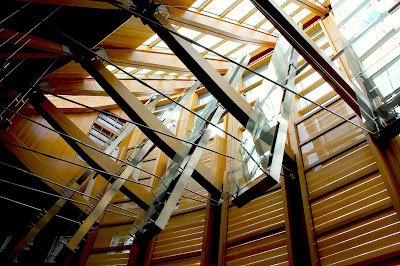
As if we hadn't already had enough amazing experiences for one day, we moved on to our tour of the Scottish Parliament. Oh man, I have so much to say, but I'll try and keep it brief. So, the Parliament of Great Britain (you know, that thing at Westminster), devolved some power to Scotland beginning in 1997. Wait, wait, wait, remember that date 1707? That's when the Scottish Parliament and the English Parliament were dissolved and merged into the Parliament of Great Britain. So, that covered the legislation of England and Scotland from 1707-1997 -- which is quite a long time! Alright, so Scottish Parliament - the building itself wasn't actually opened until 2004, which does not surprise me having been in it. It's a bit of a masterpiece. So we come in and put our special pink lanyards over our heads to show everyone we're special and then start our tour. The architecture was very modern and quite stunning, but also had a lot of important symbolism. For instance, the St Andrews cross (the cross on the flag of Scotland and therefore a completely secular symbol) could be seen in all sorts of creative places from the ceiling to the floor -- quite literally. It was made almost entirely from oak wood as well, giving it a very warm feeling.

St Andrews crosses on the ceiling of the Scottish Parliament

The lobby of the parliament is a perfectly public place anyone can come in and use!

This is the debate chamber in the Scottish Parliament - talk about gorgeous

The sun roof of the debate chamber in the Scottish Parliament

On of the hallways inside - the ceiling is supposed to look like leaves 

One of my favorite moments of the tour was the tapestry pictured below that was made to symbolize Scottish history. At the far left, it's all black with a few Scottish flags representing the distant past of Scotland and all the stories and moments that are shrouded in the doubt of the deep past. Certain crosses throughout the tapestry represent certain things; so white represents a unifying event, and black symbolizes an event with lots of death and loss. There are also hidden messages in block letters, which, of course, I can't remember, but they referred to Scottish nationalism.

The tapestry of Scottish History

After our tour, we were lucky enough to get a chance to sit down with a current member of the Scottish Parliament (MSP) called Jenny Marra. Ms. Marra is a member of the Labour party's shadow cabinet in the Scottish Parliament. As you may know, the Labour party in Scotland has recently met a huge obstacle in representation in the Parliament of Great Britain due to the success of the Scottish National Party (SNP) - out of the 59 seats Scotland holds at Westminster, Labour won only one of them, while the SNP won 56.

My question for Ms. Marra was what some of the reasons are for the discrepancy between independence being voted against last September and then the Scottish National Party winning the vast majority of seats in the British Parliament in the most recent election in May. As expected, Ms. Marra had many interesting insights. As many know, independence was voted down last September 45 to 55. One of the more interesting tidbits was how those who voted "yes" for independence are referred to as "45-ers" because of the voting record. Interestingly enough, the number 45 has had significance in the realm of Scottish nationalism for a number of years, namely because of 1745, the year of the Jacobites' Battle of Culloden. Ms. Marra also noted that the 2-year campaign for independence was very similar to President Obama's first campaign in that they both emphasized hope and change. Anyway, Ms. Marra made sure to mention that she, being a member of the Labour party, does not support independence and was instead part of the "better together" campaign.

 In considering the inconsistency between voting against independence and the bounce back of the SNP in the general election, Ms. Marra said some level of bounce back was expected, but not nearly the amount the SNP gained. So why was the SNP so successful? According to Ms. Marra, the SNP knows how to run a good campaign. For the referendum, the party was successful in lobbying for and achieving a lower voting age, considering that younger people were more likely to vote for independence. However, Ms. Marra said that when polls were taken across Scotland in schools, the proportion of those who wanted independence and those who didn't were about the same as those of the general election, so although these efforts might not have helped the odds of independence much, it still catalyzed the voting age in Scotland to be lowered to 16 for electing members to parliament and in referendums. One reason Ms. Marra stated for why the SNP was able to make such a splash in the last general election is the leadership of Nicola Sturgeon. Besides her general appeal and excellent political skills, Ms. Marra suggested it is a popular time for female leadership as well. One particularly brilliant move on Ms. Sturgeon's part was pitting the SNP against the Conservatives, not Labour, in the general election. Labour is a more liberal party than the Conservatives (unsurprisingly), so Sturgeon was able to create a duality with greater polarity in the general election by contrasting her party with the Conservatives.

The group of us talking to Jenny Marra in the Scottish Parliament

It was very interesting being able to talk to a member of the Scottish Parliament in the Labour party about the SNP and the independence referendum. Based on interactions the locals, at least in Dundee, I've really only been exposed to the perspective for independence. Although, Ms. Marra did mention that Dundee is considered a "yes" city, so perhaps Glasgow will present a different perspective. More on what the locals have to say about independence later though.

So, in order to relax a little after our thrilling time at the Scottish Parliament, we crossed the street and toured a castle for an hour (relax, ha). Not just any castle though, the Queen's Scottish Residence, Holyrood Castle (pronounced Holly-rude). It was named after the Abbey that stands in ruins next to it which once supposedly housed a fragment of the cross Jesus was crucified on (holy + rood, which was an Old English word for cross), but our tour guide suggested that was probably just something they said to entice early Christians to take pilgrimages to the abbey.

Holyrood Abbey - right next to the castle

Anywho, Holyrood was very crowded and touristy - more so than any castle we've seen. It was very lavish, of course, and our tour guide was able to tell us of many impressive occasions and moments that occurred - and still occur - in the castle such as the knighting of Sir Sean Connery. The most impressive part of the castle, for me at least, was Mary Queen of Scots's bed chambers. Our tour guide told us a rather chilling story of the room where one of Mary's personal secretary and good friend, David Rizzio, was suppering with Mary with a few other friends in her chambers when Mary's paranoid second husband Lord Darnley barged in with a group of Protestant nobles, dragged Rizzio out of the supper chamber across a room, and proceeded to stab him no less than 56 times. Talk about excessive. Oh, and Mary was 6 months pregnant.

Here's a portrait of the Murder of David Rizzio, although a) Mary does not appear to be pregnant and b) that room is not that big, let me tell you
The courtyard at Holyrood Castle

The whole squad outside Holyrood Castle

Think our day in Edinburgh is over? Not even close! Next we hopped in a taxi and headed to the U.S. Consulate. It was casual - not. We changed into our finest garmets in order meet with the staff at the U.S. Consulate in Edinburgh and a U.S. diplomat, Fleur Cowan, currently stationed in London, but working on relations in Iran. It's very complicated.  We had a lovely meet and greet with Ms. Cowan and the other staff members and were able to ask her what it was like to work in the foreign service. Ms. Cowan has spent time in various countries serving the United States and speaks seven languages. She walked us through a normal day as a diplomat, mentioning how important collaboration and staying up to date with politics is for their team. Between this visit and the British Council, I'm confident many of us were considering a potential future in the foreign service.

The group with Fleur Cowan, U.S. diplomat

After our visit with the diplomats, we stayed at the consulate for a reception that hosted people from all over Scotland. There were several students and Professors from both Dundee and Strathclyde along with high school students who were interested in studying in the States. My favorite conversations were those with the younger high school students. They told us we had accents and couldn't believe we were so excited to be in Scotland. They also were flabbergasted that we had yet to try Tablet (a harder, carmel-y fudge), Haggis and Irn Bru (pronounced Iron-Brew), which I went out and tried today since they insisted it was very tasty. It's not. It's less sugary soda that tastes like bubblegum cough syrup, but at least I tried it, right?

Here I am trying Irn Bru, the Bubblegum Cough Syrup Soda in the Dundee Student Union

So, after our day in Edinburgh, we were exhausted, as you might imagine. We all slept quite well Wednesday evening and were well rested for our day of Forensics!

On Thursday, we spent an amazing 7 hours in the Forensics department at the University of Dundee. There were three main highlights. Firstly, in our opening lecture, Dr. Clare Lamb discussed one of the most important advancements in the study of anatomy, Thiel Embalming. This method of preservation of the human body leaves tissue soft and much more lifelike, so that observations and experiments are significantly more accurate to the live human body. But get this, Dundee is the only university in the UK that offers instruction in Thiel Embalming and the technique isn't used at all in the States. What?! This is the best way to preserve the human body and study anatomy out there and the U.S. isn't using it? We couldn't believe it. When asked why this is, Dr. Lamb had a depressingly simple explanation: most of the literature on it is in German. Sure, there are costs associated with it, but the research advancements are totally worth it, especially with all the crucial medical research done in the States. My own sister actually works for a translation company, so I made sure to tell her to get on that.

The second highlight was being able to see and touch body parts preserved with Thiel Embalming vs. the older method (which basically plasticizes and hardens all tissue for preservation), which effectively demonstrated the assets of Thiel Embalming. Yeah, it was little eerie to hold a human heart in my (gloved) hands and manipulate a dead hand's tendon to make the finger move, but it was clear that preserving tissue in its soft state would lead to much easier and effective medical research. Plus, our bio majors Patty and Nina were tweaking with excitement, which is always fun to see.

The final highlight of our day of Forensics was the facial reconstructive portion. Dr. Christopher Rynn walked us through the process of facial reconstruction and how it's evolved over time. Dundee's facial reconstruction services are used for several criminal cases a year and for many other services as well. Although the scientific portion of the lecture was absolutely fascinating, my favorite part was when Dr. Rynn discussed race and facial reconstruction. He told us about how the "Cross-Race Effect," or basically how if you're a member of one race, you might think everyone from another race looks very similar, is rooted in skulls and psychology. Because when we see another face, our brain automatically compares it to our own, we're used to comparing differentiating features that result from our own skull shape - so for me, I look for differentiating factors that result from a caucasoid skull. Because people of Asian decent (and Native American, actually) all have mongoloid skulls, that's the main distinction I, as a caucasoid, see. So I might think most Asian people look the same since my brain is comparing their faces and skulls to my own, which are fundamentally different. There were so many other interesting factors of forensics and facial reconstruction that contribute to racial relations, but I've written enough on the topic for now. Ask me upon my return if you'd like to know more.

We also got to play around with the facial reconstruction computer technology in the forensics lab! The pen in my right hand actually felt resistance when it contacted a part of the virtual skull! How cool is that?!

We got off from Forensics a bit early, so we headed over to the Student Union to meet up with some of the Union Board Dundee students. We spent a lovely night with them learning about their culture, and UK culture altogether since one of the students was from Newcastle, England and one was from Northern Ireland. We played a game with them where they had to name all 50 states in 6 minutes. I won't lie, the first time I did this, I only got about 44 - these Brits ended up getting 49! Granted, we helped them a little, especially with New England. If you're curious, the one state we all forgot was Montana - sorry Montana!

Also, everyone knows who Bernie Sanders is and totally loves him here. Classic Europe.

Beyond playing games, we compared political systems and student life. We were both equally shocked at our differing costs of school. If you live in Scotland, you can go to university in Scotland for free - what's that? Did you say free?! Why yes they did. If you're from another country in the UK, you have to pay a few grand and you're good. Also, if you have student debt, you don't have to start paying it until you make 23,000 pounds a year, and if you haven't paid it off in 30 years, it's completely forgiven. Wow, sounds like a good deal, doesn't it? Then we told them what each of us were paying for college and their mouths dropped. We all agreed Scotland has the better deal here.

Finally, I asked them all about independence and devolution. Most of the students were for independence. When asked why, they said they were for it in the first place because it would make legislative issues more simple (more on that in a moment) and it was economically viable. Apparently, in 2007 (right before the recession) the Royal Bank of Scotland was the biggest bank in Europe and all because of donations from Scots themselves. To Derek, one of the students, this proved that the Scottish people were willing to make sacrifices for independence. They also mentioned that one big reason used to argue against independence is that Scotland would most likely accumulate a 3 billion pound deficit, but as the students pointed out, that's much less than the U.K. deficit and American deficit and several other European nations. These among other reasons they cited supporting the idea that Scotland could easily be economically independent convinced them of Scottish independence.

Another fascinating aspect of UK politics we discussed was devolution. So, I've talked about this before and we know Scotland, Wales and Northern Ireland have their own governing bodies whether they're parliaments or assemblies as of rather recently. So, there's a parliament of Great Britain which represents all 4 nations within the United Kingdom. Here's a handy chart from Wikipedia to show how many seats each country has!


Number of seats for each country in the British Parliament. Thanks Wikipedia!

Okay, so each country is represented decently in the UK parliament. Apart from that, Wales, Scotland and Northern Ireland have their own bodies with devolved powers that they can regulate and the UK cannot. However, note that England doesn't have their own parliament with devolved powers. So England just uses Westminster for the powers that were devolved to all the other nations' parliaments...which all sounds well and good until there's an issue being addressed in the UK parliament that's only relevant to England and the representatives from the other countries get to have a say in it because of their seats. This actually recently came up in the issue of Fox hunting. In Scotland, it's already illegal to hunt foxes, but in England and Wales, it was being voted on. Scotland believes the practice is morally wrong, so the SNP threatened to block the vote even though it wouldn't affect Scotland at all! This seems a little unfair. The students at Dundee told us they thought Scotland should be independent, but if not, England should at least get its own parliament with devolved powers so it's all equal and all this complicated political stuff doesn't happen as often. I asked why the English parliament isn't an argument that's gone anywhere and you know what they said? Apparently, England doesn't want their own parliament! This seems very strange to me, but maybe I'll find out why later on.

Okay, wow, this is turning out to be quite the long blog post, so I will postpone writing about today until the next one. Thanks for reading! I know it was a doozy.

Cheers till the next one!