Monday, July 27, 2015

Sunshine, Stirling, and Stairs

Saturday was sunny! Nearly all day even! Which was lucky for us since we spent a lot of it outside.

We met John outside our flats Saturday morning for a walk through a new part of Glasgow. We walked down High Street getting bits of Glaswegian history along the way and eventually came to the Glasgow Green. The Glasgow Green is one of my favorite places in Glasgow so far. It's a large park made up of huge fields of grass, elegant lines of trees, and several historical monuments. However these monuments weren't all for war heroes and politicians - they were for more localized citizens and popular movements specific to Glasgow. There was even one for those who opposed the first World War, which I thought was especially fascinating. My favorite monument was to the women of the Temperance Movement given the irony of temperance in a country with such an emphasis on drinking in its culture.


The monument to the Temperance Movement in Glasgow Green
The Glasgow Green also shares a space with something called the People's Palace, another testament to the importance of the people themselves to Glasgow's identity. The People's Palace is a rather small museum devoted to the history of the people of Glasgow themselves. The exhibit details marriages throughout Glaswegian history, what school was like, the Temperance Movement, what jail was like, a favorite dance, homosexual history - it was all a lovely testament to the identity of Glasgow. The people of Glasgow are so embraced by their own city that the city's slogan itself is "People Make Glasgow" - which as Neil (our student ambassador) pointed out to us, is quite brilliant since you can add any word to the end of that phrase as well such as "People make Glasgow...musical" or "smart" or "beautiful" etc.

The People's Palace - quite literally named, clearly


The Commonwealth Games (an every four year sports affair at which all British Commenwealths, including former ones, compete against one another) were held in Glasgow last year, and this was their mascot, Clyde. He serves as another example of Glaswegian identity and pride. 


Outside the People's Palace is a lovely Terracotta Fountain (the largest in the world actually!) called the Doulton Fountain. On top sits Queen Victoria looking out on her empire. This domineering statue of Queen Victoria is all over the city and apparently was erected during Britain's imperialistic moment in history as a symbol of the empire. Part of me wonders what would happen to these imperialistic images if Scottish Independence were to occur - but another part acknowledges that Scotland deeply values its history, and would probably keep them in place as a testament to their past and the massive legacy of English rule they had to overcome to be independence.

All of us outside the Doulton Fountain

After the People's Palace we got some lunch at a lovely pub nearby that supposedly sold the best beer in Glasgow - ironically it's German beer - but the food was certainly lovely.

After lunch, Neil brought us to the Merchant City Festival. We are so lucky to be in Glasgow for this festival. It is such an excellent representation of Glaswegian culture. Everyone is out and about on the streets looking in on the booths that are all completely decked out with either delicious deserts, crazy food, or little Scottish trinkets. I have never seen a more extensive street festival in all my life. We all had a lovely time exploring and talking with the vendors, trying amazing deserts and enjoying the musicians on the street. By the way, every single time we've been on the streets of Glasgow, there's always a street musician playing. From all ages and all types of music, there hasn't been one time without music - a lovely testament to the artisticness and creativity that is bursting from this city through every outlet whether it be music, film or theatre.

The Merchant City Festival in Glasgow

I was super excited to see the spread at the dessert booths - who knew Turkish Delight was actually delightful?

Although the music and the festivals are pretty grand, there is one thing I love even more about Glasgow - the police boxes. People, the Doctor could land the TARDIS in this city and no one would find it even remotely out of place. There are police boxes of every color throughout the entire city, although I like the blue ones best.

Me with a green TARDIS

Me with THE REAL TARDIS - shame on all the nonbelievers


After spending hours exploring the Merchant City Festival, we headed home to get some rest.

On Sunday, we all kind of split up and did our own things. History nerds as we are, Liam and I decided heading to Stirling was our top priority. As you might recall, Stirling is the location of the ever important Battle of Stirling BRIDGE - that's right Mel Gibson, the Battle of Stirling BRIDGE was on a bridge. Of course, it fell during the battle, so it's no longer there, but we were super duper close to where it was! By the way, all the Braveheart debunks are on a previous blog post - do take a peak if you haven't already. It's important.

Right, so Liam and I took a quick train to Stirling and were quickly smitten with the small town. It's quite historical. It even has little blue and gold signs throughout the whole place explaining the historical significance of old churches, buildings and bridges. Naturally, we loved that. We were a tad hungry when we arrived, and happened upon LORD DARNLEY'S HOUSE. If you don't recall, Lord Darnley was Mary Queen of Scots's second husband -- you know, the one that flew into murderous rages on occasion and killed David Rizzio in front of his very pregnant wife that one time. Good stuff. Anyway, it's casually been turned into a coffee house aptly titled "Darnley Coffee House." Naturally, Liam and I chose this place to stop for a bite. It was quite small with a couple decently sized rooms and the characteristic short doorways. It was a perfect start to our history-filled day.

The Darnley Coffee House - Lord Darnley's actual house


After our lunch, we headed up a hill and happened upon an awesome-looking church. Classic Scotland. We peaked inside and discovered it is the Church of the Holy Rude which Mary Queen of Scots worshipped in and John Knox preached in! We were tweaking with excitement.

Church of the Holy Rude

Inside the Church of the Holy Rude

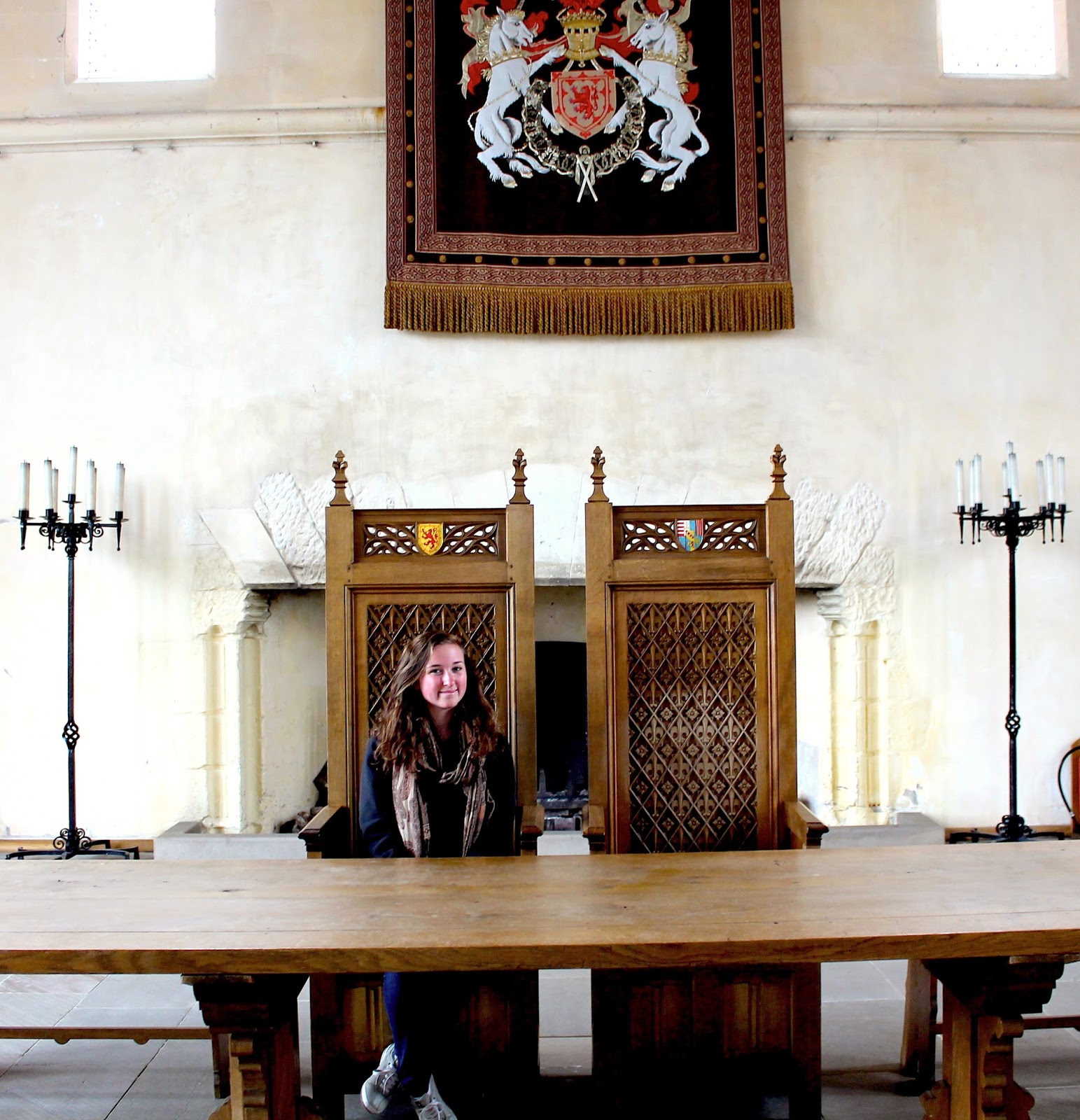
After poking around the Church, we walked up the road to Stirling Castle itself. Wow, there was a lot of history in this building. It's been sieged 16 times - half of which are by the English and the other half by the Scottish trying to take it back from the English. It's switched hands between the two many times and it's all rather confusing. Mary Queen of Scots along with several other important royals had been baptized in that very church and many of the James's (James V, James VI/I etc.) lived there as well! The decor was fantastic and we really loved our tour guide. He liked his sound effects - especially shouting "BOOM....BOOM BOOM!" when discussing castle sieges. My favorite part was a huge room they call the "great hall" used to host parties by the likes of Mary Queen of Scots herself. Our tour guide told us that she once hosted a three day party that required her to take out the equivalent of 12 million pounds in that very room.

Stirling Castle

Stirling Castle

Chilling on the throne in the room where Mary Queen of Scots threw down


The most interesting part of the castle was that it was essentially completely restored to how it might have been in the 17th century and earlier. In fact, the castle had been used by the military up until 1964 which is when Historic Scotland began to restore it. So the inside of the castle was very cartoonish in its bright colors and restored decor. It was kind of an odd effect since it looked so new but was trying to replicate something so old.

An example of one of the restored rooms - check out that cartoon-like ceiling!
The biggest benefit of Stirling Castle, I think, are the views. It sits on a hill, so the views of Stirling were absolutely breathtaking.

After finishing up at the castle, Liam and I were left with about 3 hours until our train left. He was feeling very ambitious and somehow convinced me that we could go all the way to the Wallace Monument and back in time for the train - I was skeptical, but I'm very glad he convinced me. It was well worth the mile or so it took to hike there...and uphill, I might add.

The view of Wallace Monument from Stirling Castle
 So we hiked across the river - yup, the very river that the English had to cross on the BRIDGE to meet William Wallace and the Scots at the Battle of Stirling BRIDGE. Did I mention it happened on a bridge? Silly Braveheart. Anywho, Liam and I crossed a bridge (not the bridge...remember, that one fell during the battle) near where the bridge once was and soaked in the historical moment. We found some monuments to the battle and made our way to the castle-like monument that commemorated it all.

Me on a bridge, not the bridge, near where the Battle of Stirling took place


By the way, the whole town of Stirling, unsurprisingly probably, is devoted to William Wallace and that battle. Something on nearly every block is titled "Wallace This" and "Wallace That" - which is quite charming actually. Again, a lovely representation of the differing identities of each Scottish city, but how each one fully embraces their identity.

Right, so we made our way to the Wallace Monument and ended up climbing to the very top. Guess how many steps there are? I'll save you the time, it's 273. Let me show you what the 273 steps look like:

Imagine climbing 273 of these tiny steps on a spiral staircase - if I didn't know what dizzy felt like before, I know now
The crazy staircase was totally worth the top though. Even though there was crazy amounts of wind and quite a bit of rain, the views from the top of the Wallace Monument were absolutely stunning, and the struggle it took to get there certainly made us consider the struggle Scotland has been through for greater independence and arguably still goes through today.


The Wallace Monument up close


As I said, the top of the monument is quite windy and a tad damp

The view from the top of the Wallace Monument

After our rather exhausting climb up and down the 273 stairs, Liam and I were ready to head home on the train and get back to our lovely warm beds in Glasgow.

That's all for now! Cheers till the next one :)


Friday, July 24, 2015

Precipitation, Paradoxes, and Plays

So, we've been in Glasgow for several days now, and let me tell you: I will never again complain about Chicago weather. Well, I might still complain about the extreme winters, but during the spring, summer, and fall, I will never complain again. It rains on and off and on and off all day, every day, here in Glasgow. Clouds or sunshine, it could rain at any moment. Mind you, when the sun is out, it gets pretty toasty but as soon as the wind pushes the clouds to cover it, it's freezing again. The rain could last five seconds, it could last five hours. It could be a downpour or a light drizzle. It's so unbelievably unpredictable.

One of the other differences between Glasgow and Dundee is the hills. Of course, Dundee certainly had its fair share of steepness, but Glasgow is on another level. Edinburgh as well, come to think of it. As we walked around the city our first day, we were all rather nervous as we walked straight down a sidewalk that was inclined at about, I kid you not, a 60 degree angle. I asked our staff contact, John, if people ever slipped down these streets and he laughed and said "oh yes." Given my experience with icy Chicago winters, this thought was terrifying.

Anyway, Glasgow itself is pretty interesting. Our first impression of the city centre was that it looks awfully familiar. Not familiar because we've been in Scotland for a couple weeks now, familiar because we've lived in the States our whole lives. The city center is lined with stores like H&M, Forever 21, and even the Hard Rock Cafe. Honestly, it looks a lot like Boulder, Colorado, where the entire "street" is made up of cobblestone or brick walkway and shops lining the sides. Of course, the city is still distinctly Scottish in many respects given the presence of our friends the seagulls, statues of historically important figures sprinkled throughout and of course, double decker buses.

The streets of Glasgow

Our first full day in Glasgow began with a lecture called "Inspiring Innovation" by Dr Steven Graham, the executive director of the Technology and Innovation Centre (TIC) at University of Strathclyde. This building is particularly important to the University of Strathclyde. The Queen actually officially opened it only a few weeks ago! The building represents the university's drive to continue innovating and bringing innovation to the public. The building is accessible to the public and has meeting rooms, seating, computer access etc. The TIC's goal is to give the public a place to enter the "Valley of Death." Wait, what? Yes, the "Valley of Death," which apparently is a stage in the Technology Readiness Level (the process of idea to reality) where the idea itself was formed. TIC also strives to bring the worlds of academics and business together, which Dr Graham noted can be a very difficult task, but a crucial one for success and true innovation. Ultimately, the TIC wishes to have a multidisciplinary approach to innovation involving technology, the public and even the government, bringing all the people necessary for innovation into one space to make the process massively efficient.

Squad with Dr Steven Graham at the Technology and Innovation Centre

After our lecture, we got a tour of the facilities. The building itself is only about 5 months old meaning everything was pretty brand spanking new. My favorite part might have been what's pictured below. There were several of these booths around the common area that essentially block out all sound so that one can work peacefully in a common area with a lot of people.


The sound-proof booths at the TIC

After our lecture with Dr Graham, we headed to the National Piping Centre to learn about the bagpipes! The National Piping Centre has a one-room museum full of ancient to contemporary bagpipes (including ones played at the battle of Waterloo!) along with old sheet music and different variations of pipes. Our tour guide was lovely and very knowledgeable, being a bagpiper herself for 15 years. The most interesting information included that the bagpipes didn't even originate in Scotland. The first pipes known are from 12th century Egypt and they spread throughout all of Europe not showing up in Scotland until the 13th century! Also, their original use in Scotland was by the "Town Piper" who would play in the wee hours of the morning to wake everyone up. If you've ever heard the pipes being played, you'll know that they have absolutely no volume other than loud and they would be a very effective alarm.


Everyone outside of the National Piping Centre

After learning a bit about the pipes, we actually got a chance to try them out. YOU WOULD NOT BELIEVE HOW MUCH AIR IT TAKES TO GET THE BAGPIPES TO MAKE SOUND. I cannot emphasize that enough. You have to fill the bag with air, and then blow a ton more to get sound out. When you take a breath in, you can squeeze the bag (keeping the pressure exactly the same) to continue making sound but then you better pump some more breath in soon or the sound will stop. To demonstrate exactly how difficult it was, here's a video of my own attempt:


After we all made our pitiful attempts to play, our tour guide played for us and made us all feel really good about ourselves. Not. She was really incredible.

Next we went to the Gallery of Modern Art, Glasgow. It was...modern art. I have a lot of respect for people who appreciate and understand modern art, and really, I always try to give it a chance, but I'm not a huge fan. Even so, I enjoyed our time there immensely. The first exhibit was a film in which they had bean bag chairs to lay on and lawn chairs as well. The film was super odd and I do not understand it, but I enjoyed watching.

After walking through all the exhibits, we headed back to the flats for a couple hours to relax and get ready for our Civic Reception at the Glasgow City Chambers.

This reception was one of the nicest we've attended so far. It was small, so we all got a chance to talk to everyone in attendance. The Baillie (a civic officer) of Glasgow was in attendance along with other important members of the Glasgow City Council. We also got a chance to talk with a Fulbright Scholar currently studying in Glasgow from the States, which was an awesome and very informative experience. We got a chance to discuss our lecture topics with a few of our lecturers at the University of Strathclyde as well. Our favorite part was being allowed to see the City Council Debate Chambers themselves. It was a beautiful debate room with cushioned seats featuring a gold crest, a gorgeous ceiling and overall extensive decor. The cherry on top was the chair at the head of the room donated by Queen Victoria herself, affectionately known as the "Victoria Chair."

Me sitting in the "Victoria Chair"

Most of the group at the Glasgow City Chambers

We all had a lovely time at the reception, and enjoyed our night out in Glasgow afterward. 

Friday we had two lectures: the first was a walking health history tour along the streets of Glasgow, the second a round table discussion with the National Theatre of Scotland. 

So, the health tour mainly focused on a strange phenomenon special to Glasgow called "The Glasgow Effect." Basically it's this health conundrum that the life expectancy of Glaswegians (at least those with lower income) is inexplicably lower (10 years lower) than anywhere else in Europe. Our lecturer, Dr Patricia Barton, noted the paradox of Glasgow in that it's known for its innovativeness, but also has this reputation as the "sick man of Europe." So while the city is constantly creating new solutions to problems, it seems to be unable to solve the one, arguably most important, problem it has: health. 

Dr Barton also told us a bit of the history of the city itself. The most surprising tidbit was that Glasgow was built on the trade of three items: slavery, tobacco, and opium. Yikes. Maybe that explains the health problem (joking, of course). Anyhow, Glasgow provides better access routes to the Americas than London, so it was heavily used for these profitable trades. 

Us with Dr Barton on our health tour


Another interesting tidbit from our health tour concerns Cholera, which became a health and political issue. So, cholera was most likely brought to Glasgow by washer women, one of the only groups of people that wasn't quarantined because the wealthier citizens of Glasgow had priorities in the field of not doing their own laundry. So cholera hit and the remedy used was a "hot totty," whiskey, tea, lemon and honey. To this day, my own father insists that hot tottys are a great cold remedy. Unfortunately, alcohol dehydrates your body, and didn't really help the victims of cholera out much. Anywho, eventually people thought the government invented cholera in order to obtain bodies for anatomists of Glasgow and research. I guess that tells us a lot about political efficacy and confidence in the Glaswegian government in the 19th century.

After our health tour, we went to our meeting with two representatives from the National Theatre of Scotland, Neil Murray and Elly Rothnie. The lecture was called "Theatre without Walls" and it was quite well named. So, the National Theatre of Scotland is a bit of a mystery to someone from the States. This Theatre is funded by the Scottish government with a rather generous budget. The fact that the government supports the arts so completely is so amazing, but seems too good to be true. The government doesn't even have to vet their programs! After discussing it with Neil and Elly though, it's clear why Scottish culture is a huge asset that must be conserved. In Scotland, culture is considered a resource, not a burden or a service. In fact, when asked how Independence might affect the National Theatre of Scotland, Neil and Elly were both confident that, if anything, their funding would increase. In a time of independence, having a strong and flourishing culture is essential to national sentiment and a successful transition into independence, therefore acting as a resource. As Elly noted, "culture allows a small country to punch way above its weight."

Everyone with Neil and Elly at the National Theatre of Scotland discussion

The most interesting thing about the National Theatre of Scotland is that they are the first national theatre company that chose against having its own venue. This gives the Theatre the ability to make the entirety of Scotland its venue. In fact, on their opening night, they had 10 different plays in 10 different Scottish cities open on the same night at the same time, binding the whole nation together in one night of theatre. The setting for their plays has been everything from a traditional theater setting to pubs, airports, and football fields. If all this wasn't enough, they even do international plays basically all the time. In fact, I'm extremely excited that they'll be doing one of their famous "pub plays" in my own college town, Champaign-Urbana! I can't wait to attend.

Our talks about both health in Glasgow and the National Theatre of Scotland were both extremely eye-opening and inspiring.

This weekend will certainly bring more exciting adventures in Glasgow, so cheers till then!

Wednesday, July 22, 2015

Goodbyes, Galavanting, and Glasgow

Monday, Tuesday, and Wednesday were some busy, travel-intensive days. Monday was spent in Dundee, Tuesday in Edinburgh, and Wednesday in Glasgow.

Let's start with Monday, what was essentially our farewell to Dundee. We started the day with Graeme discussing our time in Dundee and what's expected of us in our assessments -- that's right! We don't just galavant around Scotland without any word or grades! We actually have to complete journals, an essay and a presentation. So this really is summer school - although it sure doesn't feel like it. 

After our debrief with Graeme, we headed over to an administration building to meet with the Principal and Vice-Chancellor of Dundee, Sir Pete Downes (just knighted a few weeks ago!). Sir Downes told us all about the "transformation agenda" of Dundee and how far Dundee has come so far. Dundee is a hugely impressive university, and it's come a long way from its initial split in 1967 from being a part of St Andrews. For instance, Dundee is now #1 in the UK in research in life sciences, which was no surprise to us given our time learning about Thiel and advancements in forensic facial reconstruction. My favorite part of our talk with Sir Downes was when he described the model Dundee has adopted in order to become the best university in Scotland. He said their model was brought to the university by one particular head of a department in the sciences who insisted on appointing people who were better than those already in the department - including himself. Think about this! It would be so difficult to bring people into your work space who were more effective than you, therefore threatening you and your job! However, obviously, this is better for the company, business, school, whatever, itself. This was a model I immediately thought could never be followed in the States. We're too competitive in the work environment stateside, but in Dundee, this model has brought the university status and success. This is an idea that I hope not to forget in my own professional career, especially since Dundee has proved that it is successful in the realm of education. 

Sir Pete Downes, President of Dundee University, outside the Life Sciences Building (image from http://www.thecourier.co.uk/)

We also asked Sir Downes about Scottish Independence, and he brought up two very interesting points about the issue. Firstly, Sir Downes himself as an Englishman, would be made to be an ex-pat working abroad if Scotland were to be independent. Thus, he pointed out that there's an emotional element to Scottish independence that could be negative for ex-pats from England, Northern Ireland and Wales as well. The other fascinating point he brought up about independence was the irony that results from the SNP majority in Westminster right now. The SNP is obviously working to make life better in Scotland and represent Scotland as best as possible in England right now, however, if they're successful, the vote for independence will be vastly less likely. So the SNP is a bit stuck right now because if they do too much good for Scotland, people will be convinced that independence is unnecessary, but if they don't do their jobs effectively, they'll inevitably lose seats in the next election. There are so many levels and perspectives of Scottish Independence - it's so interesting to watch them unfold. 

After our lovely day of lectures we went to the Apex Hotel on the waterfront of Dundee for our farewell dinner. There we ate an amazing meal with Graeme, Pat, Daria and Keegan. It was certainly a bittersweet, but highly enjoyable time as we prepared to leave Dundee to spend the next two weeks at Strathclyde University in Glasgow. 

Matt, Nina, and Omar at our Dundee farewell dinner at the Apex Hotel

The next day (Tuesday) we hopped on a bus with all our luggage and headed off to Edinburgh, our old friend. We had essentially the whole day to ourselves, which was most welcome since our first day in Edinburgh was jam-packed with (amazing) activities. 

We started the day off with a walk to Edinburgh Castle, the castle that inspired none other than Hogwarts itself. So, we walked up the Royal Mile until we found the entrance to the castle, pictured below.

Edinburgh Castle from afar

The entrance to Edinburgh Castle, flanked by William Wallace (left) and Robert the Bruce (right)


The Royal Mile is arguably the most touristy part of Edinburgh. It stretches from Edinburgh Castle all the way to Holyrood Castle and the Scottish Parliament, and the street itself is lined with whiskey shops claiming to be the best whiskey in Scotland, the most touristy of tourist stores and plenty of pubs. Oh and don't forget about the advertisements for witchery tours. Lots of those too. 

The Royal Mile - note the advertisement for "Witchery Tours" as promised

We decided Edinburgh Castle was just too touristy for us to spend all the money and the time on the interior tour, so we walked around in the free part for a while and moved on. The next stop to be made was the ever-important Elephant House Cafe, the "birthplace" of Harry Potter, as it were. This cafe has a perfect view of Edinburgh Castle on its hill of rock and grass that served JK Rowling's imagination very fittingly to inspire Harry's story and the castle it takes place in. Here we stopped for quick coffee or shortbread cookie (in the shape of an elephant, I might add) and soaked in the warm atmosphere that Rowling herself loved so much. 

All of us outside the Elephant House!

Me, Patty and Tim hanging out in the Elephant House where JK Rowling once wrote!

The Cafe has a drawer full of letters written to/about Harry Potter or JK Rowling -- this one's from France and has a drawing

After our coffee, the group split up (cue dramatic music) to accomplish two different activities. One group decided to hike up a practically vertical mountain called Arthur's Seat, which is notorious for its amazing views, and the other decided to see the Botanical Gardens. I was in the latter group, my family and anyone whose ever hiked with me much before will not be surprised to know. So, while the larger group hiked Arthur's Seat, me, Nina, Patty, Jael and Matt got sidetracked on the Royal Mile shopping around, going on the Ferris Wheel, and then going on a freaking amazing tour of Mary King's Close. 

Let me tell you about Mary King's Close. So, this was one of the things I really wanted to do while I was in Scotland, so I'm very pleased my friends agreed. This is one of the most haunted places in Europe, and if you went on this tour, you would not be surprised at this fact. So, firstly, what's a close? A close denotes a rather narrow street lined by up to 12 floors worth of tiny flats (more or less) or shops or whatever, usually providing a pathway away from the main street. Here's an example of what one might have looked like: 

Patty walking up something that might be considered a close

So, what's so special about Mary King's Close? A LOT OF THINGS. 

1) This is a street named after a woman in the 17th century! Not even a particularly rich woman! She was the mother of 4 children who had been widowed, but closes were typically named after very prominent or important people who lived there, so she must have been a very successful and important woman indeed. 

2) It dates from the 17th century and earlier! 

3) There were plague victims there! (Wait, wait, wait, Lisa, I know my history and therefore, I know that the plague was in the 14th century!) Alright, so the main plague that we hear about in AP European History and World History definitely hit in the 14th century, however, plagues hit different places at different times all the time! One hit of the plague was particularly bad in Edinburgh in 1645 including Mary King's Close. 

Now, there are a lot of stories of plague victims being walled up in the close and left to die, but those stories aren't entirely rooted in fact apparently (which, not going to lie, bummed me out a tad), but of course, the true stories were just as horrific. Lots and lots of people died during this hit of the plague throughout Mary King's Close. However, there was hope for those who had the bubonic plague (if you had the pneumonic plague, you were pretty much done for). There was a "doctor" of sorts who could help those with bubonic plague by cutting open the puss-filled sores, draining them, and singeing them back together with a hot iron, and thereby giving them a 50% chance of surviving. Great odds. Anyway, the only reason this dude survived was because he wore this totally crazy outfit which consisted of a body-length leather shawl (particularly impervious to little things like fleas which, I dunno, cause the plague) and a freaky mask with a raven beak. Here's Nina modeling the mask: 

Nina and the plague mask

The mask was filled with oils to ward off evil spirits and demons, but the oils actually may have helped ward off the plague itself. So, the plague doctor of Mary King's Close and plague doctors throughout Europe actually might have accomplished something by wearing this creepy outfit. 

So. What's the most interesting thing about Mary King's Close?

It's underground. 

It's just hanging out underneath Edinburgh right now. They built the Royal Exchange on top of it at some point and kicked all the residents out with a 40 pound stipend. Jackpot! 40 pounds to find a new home and livelihood, whoopee!

Well, almost all the residents got 40 pounds. One got 400 pounds. How, you may ask? By being difficult. Mr. Chesney really liked his house on the close and was not happy when asked to leave, but when he was offered 400 pounds (about 40,000 pounds, and way more US Dollars, by today's standards) he couldn't exactly refuse. So he left his little home and the toilet he was very proud of (titled "Thunder Box" - how appropriate) for better things. 

Okay, last story about Mary King's Close. So, there's one room that's maybe legitimately haunted. Apparently a psychic from Japan came to the Close to see if there was any paranormal activity going on. She found nothing. Nothing! How could that be? So many people died from the plague among other horrific things! So she found nothing except for one thing in one tiny room. In this room she felt a presence, and when she tried to leave something grabbed her dress to pull her back. She turned around and saw a small child. The child called herself Annie and said she died of an illness and was abandoned by her parents. The Japanese psychic determined she was there because she wanted her stuffed toy, so the psychic went out to the Royal Mile and bought her a barbie after which Annie vanished. To this day there is a huge pile of stuffed animals and toys for girls left by those on the tour for Annie. It's kind of eerie actually. Not to mention the hugely noticeable drop in temperature in Annie's room. No joke. It's freaking cold in there. 

Here's a picture of what the close looks like today with some artificial lighting (image from theguardian.com)

There are more really interesting and frankly, haunting, stories about Mary King's Close, but you'll have to ask me more about them in person as I've already written too much about this one experience. 

Alright, after the Close we met back up with the rest of our group at the hotel to change and go to the good old Scottish Parliament for a photography exhibition curated by the University of Dundee archives. The exhibition was called "Michael Peto Photographs: Politics In Focus," and it was really cool. We felt so fancy all dressed up in the Scottish Parliament analyzing black and white portraits of important political names and faces. Some interesting people featured in Peto's photographs included Winston Churchill, Nelson Mandela, Ian McKellen, and John Lennon. They were a truly stunning collection of portraits with fascinating stories behind each of them. I especially appreciated the prevalence of important women in Parliament in one portion of the exhibition. 

There was another photo exhibition going on at the same time in another portion of the parliament called the World Press Photo Contest. Each member of our group was particularly struck by the group of first place photographs titled Family Love by Darcy Padilla. This was a striking series of photos about AIDS victims and how it affected their lives and the lives of their children. Each display was very touching, emotional and creative - some more political than others. I highly recommend you all checking out their website to see more about the exhibition and the stories it tells about our world at their website: http://www.worldpressphoto.org/collection/photo/2015

We were all absolutely exhausted after the exhibition and our meal afterward that we all headed back to the hotel to crash. 

The next morning (Wednesday) we hopped on a bus to arrive in Glasgow for the first time! We met up with our staff contacts, John and Neil, and were shown around the city for the first half of the day. Glasgow is the biggest city in Scotland and many people consider it Scotland's New York City. We could all see why. There was a Forever 21 on your left and a Hard Rock Cafe on your right. The buildings were taller than we were used to in the rest of Scotland, especially Dundee, and there were way more people. Way more. After orienting us around the city and allowing us some time to get settled, we ended our first day in Glasgow at the Dakhin South Indian Restaurant where we got a taste of Scotland's Indian Cuisine, which was, might I add, quite delicious. 

Daniel getting ready to eat a "dosa" at Dakhin on Wednesday night and I am laughing at the ridiculous largeness of it - but it was very tasty (photocredit to Patty Esch)


We're all greatly looking forward to our time in Glasgow at the University of Strathclyde. Can't wait to tell you all all about it. Cheers till then!


Sunday, July 19, 2015

Forests, the Funnies, and Golf

Friday, Saturday, and Sunday were some of our last days in Dundee, and after our jam-packed week of activities, we took our opportunity for a rather relaxing weekend.

Friday morning and early afternoon was spent in the classroom with Dr Chris Murray and Dr Jim Stewart (by the way, they just don't put the period after Dr. and St. and Ms. etc. like we do in the states). Dr Murray's lecture was titled "Comics: The Scottish Connection." Comics are actually quite important to the economy of Dundee, which I believe I mentioned earlier. This is largely due to the fact that it's the location of the large and prevalent publishing company, D.C. Thomson, that is especially famous for its cartoons. As a result of this, Dundee is one of the only universities with a PhD program in comic studies. During our lecture, Dr Murray walked us through understanding the definition of a comic and how that has changed throughout our past. For example, one could easily say hieroglyphics are a form of comic; however, another potential "first comic" could be Benjamin Franklin's "Join or Die" diagram during the American Revolution.

Ben Franklin's Join or Die cartoon - a potential candidate for "first comic" (image from shmoop.com)

Lecture moved on to two PhD students showing us a comic they were working on themselves. One interesting aspect of comics that I never really thought about was that there's often a lot of collaboration involved. Of these two students, one wrote the script and the other drew the concepts out into panels and characters. They have to go back and forth many times to make sure they're both on the same page and they agree on where the comic itself should be going. Ultimately, it was all very impressive and opened up my eyes to the world of comic creation.

The next lecture was from Dr Jim Stewart who is an English professor at Dundee, but is also the current poet-in-residence at Tentsmuir. Dr Stewart walked us through four of his poems that were inspired by his current residency. Tentsmuir Forest is just across the Tay River from Dundee and is a gorgeous forest on the Eastern coast of Scotland. It features a stupendous forest of mostly pine trees, fields of flowers, a sprawling coast, dunes, and several wheat fields. I'll tell you why I know that later. So, the first poem was by far my favorite - it was three riddles about three different animals that occupy Tentsmuir. It took us about 40 minutes, but we talked through it and figured out them all (it was a seal, a red squirrel, and an otter). I don't mean to toot my own horn, but I totally figured out the seal first, so basically, I'm a genius.

We were so inspired by Dr Stewart's poetry that we decided to take our free day (Saturday) and head to Tentsmuir for a hike. Dr Stewart did suggest that the only way to truly experience a forest is to get lost in it, so we did just that. Well, more or less. We started off our hike at "Lundin Bridge," which was poorly named since it was so tiny.

The walk begins on the coastline where the huge gusts of wind blew the sand against the backs of our legs and made us feel like we were in the middle of Tatooine. I did the best I could to capture it with the pictures below:

Squad at the beginning of the walk on "Lundin Bridge"

Daniel demonstrating exactly how intense the wind gusts were

The sand was blowing across the beach from the wind...a little too green to be Tatooine, though

 We explored the coast and got a little off-trail, but we met two friends along the way: Sally the Snail and a baby crab who remained nameless. We found the trail after our coastal exploration and began walking in the actual forest. It became much less windy, which was quite a relief, especially for poor Michael who had shorts on the whole time. We walked on the path through the forest for a few hours, stopping a few times for a break, and eventually decided to find Morton Lochs. We kept following the signs but it took us hours to find the Lochs, which weren't even that impressive anyway! On our way out of Tentsmuir, we began walking down something I can only call a "country road." We were flanked by two fields of wheat and flowers and we couldn't really see anything for miles...which was a bad sign. Luckily, Liam asked to see the map and pointed out that we were going the wrong way. Whoops. So we backtracked for a quarter mile and hung a left to take us down the correct path. By this time, we had been walking for pretty much six hours straight and were definitely feeling it. Oh well, we had a lovely time together getting more or less lost in Tentsmuir Woods. We think Dr Murray would be proud.

Patty and our friend, Sally the Snail - she didn't come out much, but we didn't take it personally

Our nameless baby crab friend
Patty, Jael, Daniel and I jumping in a wheat field

The beautiful, but less impressive than we had hoped, Morton Lochs

We all came back to the flats and took much needed showers and naps, but since it was our lovely Michael's birthday, we took him out to dinner at Avery & Co., our new favorite restaurant in Dundee (thanks for the recommendation, Katie Norton-Williams :) ).

Sunday might be the day most of you are interested. We got up bright and early and trekked over to St Andrews for THE 144TH BRITISH OPEN! We were so lucky to happen to be in Scotland during one of the few years it's actually held at St Andrews, and even more lucky that Fulbright thought it worth while to sponsor us to go there. Granted, it certainly is a Scottish experience to watch an international golf tournament being played on St Andrews's "Old Course."

Now, don't hate me, but no one in my immediate family finds golf even remotely interesting, but I could certainly appreciate this amazing cultural, athletic, and international experience. There were people from all over the world in St Andrews, and that was pretty spectacular. The golf was good too, of course. We saw players like Graeme McDowell (who Nina was particularly excited to see), Paul Dunne (the amazing Amateur who's currently in the lead...I think) and Robert Streb from the States! My favorite part of the golf-watching experience was the impressive level of silence such a large crowd can accomplish. That, and the resulting subtle golf clap I got to join in person! How cool.

Also, forgive me for the low level of pictures of the Open -- you're not really supposed to do much photographing of anything.

Squad pumped to be at The Open

Me, Patty, Nina and Omar at the 18th hole!

After The Open, we headed back to the flats to make ourselves some pasta, and reminisced on our time at Dundee. Tomorrow is our last official day before we head off to Glasgow, and we are all feeling quite bittersweet about it.

The next post will be all Edinburgh and Glasgow - woohoo city-life! Cheers till then!